


|
|
|
|
|
|
|
|
|
|
|
|
|

|
Proof Of The Removal Of Important Gospel Teachings
When will the Kingdom
Come? The disciples asked at GofT saying 22:
"Shall we then, as children, enter the
kingdom? Jesus said to them, When you make the two one, and when
you make the inside like the outside and the outside like the
inside, and the above like the below, and when you make the male
and the female one and the same, so that the male not be male
nor the female, female; ...then will you enter the kingdom." That you must overcome the Duality of male
and female to gain entrance into the Kingdom, is further stated
in the Gospel of Philip: “When Eve was
still with Adam, death did not exist. When she was separated
from him, death came into being. If he enters again and attains
his former self, death will be no more”. You will find the enigma of achieving the
Final Stage of Birth at When Man Meets Woman http://therealfactsoflife.ebionite.com/#WhenManMeetsWoman
|
|
“Men occasionally stumble over the truth, but most of them pick themselves up and hurry off as if nothing ever happened.” (Winston S. Churchill)
Many of these higher spiritual teachings that were removed from the canonical Gospels and suppressed by the Church, were preserved in the Gospel of Thomas. In the Epistle of Peter To James it is stated that if this body of higher Truths should become lost or thrown away, that "...it will remain even for those who really seek the truth, always to wander in error" And the modern Church has proven this statement true beyond even the imagination of the body of faithful believers. And while some of this higher spiritual knowledge is contained in the enigmatic teachings of the Gospel of Thomas, because the Christian world has virtually nothing in common with the Original Gospel Teachings and Objectives, they can neither utilize the knowledge and reality that these teachings suggest, because the dogmatic framework of the Church has been built upon a gravely flawed spiritual foundation that has shackled the vast majority of the Christian to a state of abject ignorance. What is not at all realized today is the great importance of the Gospel of Thomas to both the Church, and the world today. Why? Because it exclusively focuses on the great void that has anchored our modern world in an intellectual and spiritual Dark Ages that it has not even begun to emerge from. While we imagine ourselves to be the most technologically advanced and enlightened society that has ever existed, we remain blind to the chains that shackle modern man which can be portrayed in the reality of a simple Gospel proclamation in the words: "(3) Jesus said ...But if you will not know yourselves, you dwell in poverty and it is you who are that poverty". While it is true that we have split and harnessed the atom -- overcome the forces of gravity and traveled to the moon -- and we have made countless technological advances -- it remains true that because we know virtually nothing about our True Self and our Higher Soul-Reality, we remain prisoners in our own self-imposed cocoon of ignorance from which we have yet to emerge. And if we pose the question as to why this statement of dwelling in abject poverty is applicable to what many would say is the great body of knowledge that is taught in our institutions of learning today? The answer is in the enigma of the statement: "(39) Jesus said, The Pharisees and the scribes have taken the keys of knowledge and hidden them. They themselves have not entered, nor have they allowed to enter those who wish to" (see The Key Of Knowledge). "All truth passes through three stages. First, it is ridiculed. Second, it is violently opposed.
Third, it is
accepted as being self-evident." Do we dwell in a world of shadows? Man's search for truth and the answers to the virtually countless dilemmas of life can be defined from the perspective of two very opposite schools of thought -- i.e., (1) that man must study and learn the theories and opinions of other men who are accepted as teachers, authorities and experts; and (2) that each individual person possesses an innate connection to an Inner Source of Knowledge and Truth that he must learn from and acquire the ability to tap into. The first paradigm of thinking is based upon what the scriptures portray as the wisdom of this world that the Apostle Paul warns will always come to naught -- and is based upon the foundational paradigm that the child's mind is empty, and this emptiness must be filled through the acquisition of knowledge and truth from others perceived to be knowledgeable teachers. While to the detriment of modern man, the second paradigm of foundational thinking remains an enigma that is not readily understood.
"The truth that makes men free
is for the
most part the truth which men prefer not to
hear." Most people are bound and shackled to their belief -- to the degree that whatever is not in accord with their beliefs, they reject. In the following I will demonstrate that the knowledge and understanding of the first-century Christians -- many of whom personally knew and were directly taught by the historical man Jesus -- was totally different and even in conflict with the thinking and beliefs of modern Christians. But, the vast majority of people will demonstrate the wisdom of Winston Churchill when he emphatically stated: “Men occasionally stumble over the truth, but most of them pick themselves up and hurry off as if nothing ever happened.” In his famed work De Principiis, the pre-Nicene Church Father Origen wrote in reference to the proper application of the Key of Knowledge that few men even “…imagine that they possess knowledge before they really learn” -- and then adds that “…the consequence is that they never begin to have knowledge”. Why? And in the enigma of these words that few possess the insight to understand the ramifications of, perhaps even more important is the reality presented in Origen's words that men somehow "...possess knowledge before they really learn”. What this means is that even before a child or person begins to learn, they possess a Source of Knowledge that they are consciously unaware of -- and that because they attempt to acquire knowledge from outward sources, they inhibit the process of taping into the inner source of Knowledge that they are unaware of the existence within them. And the answer to the dilemma is seen in the (above) statement with respect to the second reality that "each person possesses an innate connection to an Inner Source of Knowledge and Truth that he must learn from and acquire the ability to tap into". Which gives new meaning to the words of Jean Piaget who stated: “When you teach a child something you take away forever his chance of discovering it for himself.” That all of mankind possess an Inner Source of Knowledge was known to the ancient wise men and women who understood the adage to Know Thyself. According to Socrates and Plato, the most important forms of knowledge come not from formal instruction, but by a re-awakening of already existing dormant or latent knowledge. This is called anamnesis. Under the heading of Anamnesis (Philosophy), the Wikipedia states: It is the idea that humans possess knowledge from past incarnations and that learning consists of rediscovering that knowledge within us. The article then goes on to say: Socrates' response is to develop his theory of anamnesis. He suggests that the soul is immortal, and repeatedly incarnated; knowledge is actually in the soul from eternity... What one perceives to be learning, then, is actually the recovery of what one has forgotten. (Once it has been brought back it is true belief, to be turned into genuine knowledge by understanding.) And thus Socrates (and Plato) sees himself, not as a teacher, but as a midwife, aiding with the birth of knowledge that was already there in the student. A person of a linear-mindset who equates wisdom and knowledge as being the product of a formal education, will very likely question the perception of a Mystic and a person who seeks Knowledge within themselves while never having undergone the formal study of philosophy, theology or science. Yet, the linear-minded person seems to forget the very words of Einstein who reasoned: “The only thing that interferes with my learning is my education.” Why? Because the development of the mind through outward learning actually inhibits and atrophies the Intuitive spheres of mind which are necessary to tap into the Inner Source within the mind of the seeker (see Linear Vs Intuitive Development Of Mind ). Mystics have long warned mankind that the reality of this world of appearances is not at all what is seems to be through the perception of man's physical eyes and senses -- i.e., that there is a great deal more that man's senses and perception cannot detect or even imagine. And this same enigma of the limits of man's physical senses and liner-based mindset was noted by Albert Einstein who concluded with respect to man's dilemma when he stated: "The intuitive mind is a sacred gift and the rational mind is a faithful servant. We have created a society that honors the servant and has forgotten the gift." An important insight into the very essence, purpose and higher spiritual objectives of the original teachings of Jesus that came to be portrayed as TheWay, is contained in an article in the Encyclopedia Britannica under the heading, The History of Christian Mysticism, where it reads: “Although the essence of mysticism is the sense of contact with the transcendent, mysticism in the history of Christianity should not be understood merely in terms of special ecstatic experiences but as part of a religious process lived out within the context of the Christian community. From this perspective mysticism played a vital part in the early church. Early Christianity was a religion of the spirit that expressed itself in the heightening and enlargement of human consciousness”. What is expressed in these words is of the utmost importance. Why? Because the original teachings of Jesus was not the blind faith and belief in a prophet or god-man -- but rather, the means to transform all Christian disciples of TheWay into prophets and mystics as demonstrated in the words: "...From this perspective mysticism played a vital part in the early church. Early Christianity was a religion of the spirit that expressed itself in the heightening and enlargement of human consciousness”. But, we must then pose the question: Just what is a "...religion of the spirit"? Like an astronaut who travels beyond the limits of the earth's atmosphere into outer space, a spiritual religion prepares the seeker/disciple to transcend the barrier of this physical world, and enter into what the biblical authors portrayed as the Kingdom of God which Jesus taught was within us. But to accomplish this spiritual transcendence, you had to first prepare the physical body to make it an environment that would permit "...the heightening and enlargement of human consciousness” to be brought about -- and sadly, this requires a great amount of effort and preparation. Why is the foregoing important? When rightly understood, the scriptures are an allegorical representation of what can be portrayed as the Cosmology of Mind and Being (see An Inconvenient Truth). Which means that both the twelve tribes of Israel, as well as the twelve disciples of Jesus, are representations of the Divine Pattern that is holographically replicated into the mind of each and every person who is personified as the Prodigal Son -- and the primary objective of the scriptures is to bring about the development and Anointing (Messiah/Christ) of the mind of the individual seeker. But herein lies the problem that is restored and presented in the Gospel of Thomas: Because the mind is comprised of twelve spheres which are allegorically portrayed in the pattern of the Tree of Life -- divided across the spectrum of the Tree of Duality (aka The Knowledge of Good And Evil) -- and while those spheres of mind that look outwardly perceive an entirely different reality than their paradoxical opposite spheres of mind that look inwardly -- it is through the process of discovery and inner intuitive reflection that we begin to develop the spheres of mind necessary to tap into the Inner Source of Knowledge and receive the Divine Manna and Spiritual Knowledge (aka Gnosis). In the Doctrine of the Trinity the Holy Spirit is Feminine -- with the term Sophia being interpreted the Wisdom of the Comforter or Holy Spirit being drawn from the Intuitive/Feminine Spheres of Mind. Therefore, when our modern culture which is totally outward looking, inhibits the development of the Feminine Intuitive Spheres of Mind through our modern process of relying upon outward teachers to convey information to the student and young impressionable minds, we inhibit the development of those Intuitive Spheres of Mind that are necessary to tap into that Inner Source of Enlightened Knowledge -- i.e., the Divine Manna of the Kingdom. In the same way that an unused limb begins to atrophied -- and a person who awakens from a long coma cannot even physically function -- so too do the Intuitive Spheres of mind that fail to develop and become balanced with the Linear Spheres of Mind. Recently in a presidential debate, Dr. Ben Carson who is a retired neurosurgeon, noted that he was the only candidate who had taken out half a human brain. Then he noted that if you went to Washington, D.C. you might think that someone had beaten him to it. What Dr. Carson is totally unaware of is the reality that by virtue of our system of our cultural teaching and education, virtually all the population is limited to using half of their potential mind -- and because of the mental imbalance, it remains virtually impossible to tap into the Inner Source of Knowledge that the Church Father Origen was making reference to. Therefore, if it is true that each of us has the innate ability to tap into a Source of Truth and Knowledge that is greater than all the works ever composed by man, then when we attempt to teach and program the child's mind in the traditional environment of what we portray as learning, we inadvertently obstruct the child's ability to tap into this Inner Source of Knowledge -- thereby rendering the child mentally impotent.
After eating what was portrayed as the forbidden fruit of the Tree of Duality (a.k.a. Tree Of Knowledge Of Good And Evil), the statement was made in the allegorical account of Genesis: "The man has now become like one of us, knowing good and evil. He must not be allowed to reach out his hand and take also from the tree of life and eat, and live forever" (Gen 3:22-23). Thus, the promise is that those who eat the fruit of the Tree of Life, will live forever. That the Tree of Life is something that all of mankind can gain entrance to, and eat the fruit thereof, is demonstrated in the statement in the Revelation: "'He who has an ear, let him hear what the Spirit says to the churches. To him who overcomes, I will grant to eat of the tree of life which is in the Paradise of God'" (Rev 2:7). The scriptures were written by mystics (see An Inconvenient Truth) who composed their sacred writings to both preserve a body of spiritual knowledge which was of primary importance to sincere seekers in search of Higher Truth. To insure this body of spiritual knowledge was protected so it could be utilized by those who were the most sincere seekers, they therefore understood the importance of cloaking it in a manner that the carnal forces of this world would not recognize. These same enlightened mystics also understood that the division and separation of what is allegorically portrayed as Adam and Eve, is representative of the divided condition of male and female within all of mankind and these outer realms of Creation. This condition of division and separation is expressed in the Gospel of Philip in the words: “When Eve was still with Adam, death did not exist. When she was separated from him, death came into being. If he enters again and attains his former self, death will be no more”. A most important teaching has been preserved in the Gospel of Philip where it states: "There are two trees growing in Paradise. One bears animals, the other bears men. Adam ate from the tree which bore animals. He became an animal and he brought forth animals. For this reason the children of Adam worship animals. The tree whose gifte Adam ate is the Tree of Knowledge. That is why sins increased. If he ate the fruit of the other tree, that is to say, the Tree of Life, the one which bears men, then the gods would worship man. For in the beginning God created man. But now men create God. That is the way it is in the world – men make gods and worship their creation. It would be fitting for the gods to worship men!" The Soul of man is asexual -- i.e., a Being of Light that is the perfect balance of male and female in accord with the Divine Pattern of Creation (see http://SoulSelf.org ) -- and as a Being of Light ( http://BeingOfLight.com ), the Source of Soul-Light is in fact that harmony and balance of Paradoxical Opposites (see The Source Of Soul-Light http://SoulSelf.org/#SourceOfSoulLight ). As explored throughout the above article, all growth, development of mind and spiritual evolution is through the interaction of male/female opposites on all levels of our Being. In the same way that the embryo implanted in a woman's womb is the joining of sperm and ovum -- and the fact that when we are born into this realm which is the next stage of Cosmic Womb (see Mental Womb http://OuterDarkness.Nazirene.org#MentalWomb ) -- we can only expand the mind beyond the "animal-soul" level of consciousness through the direct interaction of the male/female columns of the Tree of Knowledge -- which is the outer divided columns of the Tree of Life. Why? Because the lower nature of mankind is a reflective (feminine) opposite of our higher spiritual nature that can only be brought into Oneness by bringing the outer paradoxical opposite columns of the Tree of Knowledge together into the Tree of Life in the Center. When the Gospel of Philip states that the Tree of Knowledge bears animals -- i.e., "One bears animals" -- what is being stated is so long as the division of these male/female columns continue to exist -- which makes it impossible for the Heavenly and Earthly Kingdoms to be brought together -- the development of mind will remain inhibited and flat-lined -- incapable of comprehending man's higher Soul-Realty. Without the interaction and re-merger of the male/female energies of the Tree of Knowledge, the consciousness of the person remains organic and what Paul portrayed as at an "animal-soul" level (see Animal-Soul http://AnInconvenientTruth.org#animal ) -- and the person basically remains controlled by their lower nature and can be portrayed as beasts who walk in the form of man. Which basically means that all the promises of the scriptures do not apply to them -- even when they call themselves Christian. This condition of division and separation is expressed in the Gospel of Philip in the words: “When Eve was still with Adam, death did not exist. When she was separated from him, death came into being. If he enters again and attains his former self, death will be no more”. Further, the same mystics who authored the scriptures understood that so long as the mind of man continues to exist in this divided state of male and female, it would remain impossible for him to comprehend his own higher soul and spiritual reality (see The Fatal Error Of The Church). Thus, when rightly understood, it is this divided condition across the gender divide of man and woman, that immerses mankind under an umbrella of self-ignorance -- a suppressed mental condition that Jesus portrayed as the "outer darkness" of mind and being (see Outer Darkness). Which meant that before a person could even begin to comprehend this higher spiritual knowledge that is the birth-right of mankind as the divine offspring of Creator-God, he has to first escape the conditions that inhibit his development. Second Epistle Of Clement: That the foregoing teaching which is contained in the Gospel of Thomas saying 22 was important to the first century followers of Jesus, is demonstrate in The Second Epistle of Clement where this ultra-important teaching that was removed from the Gospels modern Christians use is quoted as stating: “Let us expect, therefore, hour by hour, the kingdom of God in love and righteousness, since we know not the day of the appearing of God. For the Lord Himself, being asked by one when His kingdom would come, replied, 'When two shall be one, that which is without as that which is within, and the male with the female, neither male nor female’”. What Clement -- the disciple of Peter who is claimed by the Church as the fourth pope in succession of Peter -- is stating in accord with the Original teachings is that when the seeker/believer brings this condition about within their own Mind and Being, that the predicted and expected Kingdom will come within them as promised -- as stated in Jesus' teachings on the Key of Knowledge (see The Third Fatal Mistake - Not Proving The Truth). It is important to recognize that when Clement wrote the above in his Epistle to a congregation of Christians, he did so in the expectation that the people to whom he was writing would understand the great truths he was presenting to them. That the Kingdom or End Times would and could only come when "...two shall be one, that which is without as that which is within, and the male with the female, neither male nor female’”. And the fact that this statement that is in the Gospel of Thomas and was contained in a first century Epistle from an elder to a congregation of believers in that time-frame, could not be contained and understood in a letter or epistle to a congregation today, is merely one example of the fact that the dogma and thinking of the modern Church has virtually nothing in common with the original teachings of Jesus known as TheWay (see The Original Teachings Have Nothing In Common With Church Dogma http://TheCall.Nazirene.org#OriginalTeachings ). Which provokes the question: Has the requirements to enter the Kingdom changed in order to accommodate the dogmatic corruption of the Church? Has Truth and Higher Spiritual Reality been discarded and thrown away, because the Church threw this body of essential Knowledge pertaining to the Coming of the Kingdom away? Or, does modern Christians dwell in a self-imposed Diaspora of abject Spiritual Ignorance which was brought about by the massive corruption of the scriptures (see BibleCorruption.com ), and the suppression of the body of essential knowledge that is necessary to restore the lost prodigal son to his rightly place in the Edenic Kingdom of Origination. When Jesus conveyed to Nicomedus that "...Most assuredly, I say to you, unless one is born again, he cannot see the kingdom of God" -- and when Nicomedus did not understand the threefold process of birth, Jesus then asked how he could be a teacher, and not know these spiritual realities: "...Nicodemus answered and said to Him, How can these things be? Jesus answered and said to him, Are you the teacher of Israel, and do not know these things? It is important to grasp the reality of the words that when Nicodemus did not grasp the reality of achieving the next stage of birth, that Jesus replied: Most assuredly, I say to you, We speak what We know and testify what We have seen, and you do not receive Our witness. If I have told you earthly things and you do not believe, how will you believe if I tell you heavenly things?" (John 3:1-12 NKJ). Thus, if the next stage of birth was brought about by saying a prayer to the Jesus-god created by fourth century pagan Rome -- or, the sinners prayer as is commonly practiced by modern Christians -- then Jesus would not have replied to Nicodemus in this manner. He would have stated to Nidodemus that a person must say the prayer to the Messianic Lord and Savior, in order to be born again. But he did not, because this man-made dogma had not yet been invented and propagated by faux-priests who were part of the great shadow-church of pagan Rome. In the same way that genetically, the embryo that forms the body when an infant is born into this world is the merger and balance of 23 pairs of chromosomes from the mother and father, what is being presented in the words of the Gospel of Thomas -- i.e., "When you make the two one, and when you make the inside like the outside and the outside like the inside, and the above like the below, and when you make the male and the female one and the same, so that the male not be male nor the female female..." -- is the means by which the Feminine-Intuitive and Male-Linear opposite spheres of mind within the pattern of the twelve spheres of the Tree of Life must be brought into a state of Evolved Wholeness and Oneness, in order for the mind of the seeker to evolve beyond what Paul portrays as an "animal-soul" level of consciousness (see Organic Man Ruled Over By His Lower Animal Nature), and for the Kingdom to come in the manner that was promised in the Gospel -- i.e., "He who has an ear, let him hear what the Spirit says to the churches. To him who overcomes, to him I will give of the hidden manna" (Rev 2:17). Which provokes the question: Overcomes what? Overcome the division of the Tree of Duality of the person's own mind as explored in the article The Tree Of Life -- as personified in the statement: "'He who has an ear, let him hear what the Spirit says to the churches. To him who overcomes, I will grant to eat of the tree of life which is in the Paradise of God'" (Rev 2:7). Which spiritually transformative process is personified in the words of the Gospel of Thomas: "When you make the two one, and when you make the inside like the outside and the outside like the inside, and the above like the below, and when you make the male and the female one and the same, so that the male not be male nor the female female; ...then will you enter the kingdom". That the later fourth century Church of Rome threw this essential knowledge away that the first-century Christian clearly understood, does not in any manner change the requirements of birth that Jesus set forth in the Gospel. In the words of that 60’s philosopher Bob Dylan during that time of his life when he was a student of Hebrew Mysticism, when he said: "He who’s not busy being born, is busy dying"! There are Two Ways -- i.e., what Jesus portrayed as the "narrow path" of TheWay of Life, and the "broad-way" that the vast majority of mankind walks to their own demise. And if you fail to bring about the next stage of birth -- with the Second Coming and End Times coming within you, while you are still in the physical body -- it will be impossible to accomplish this necessary next stage of birth in the after-life when you pass from this world. Thereby fulfilling the statement: "Assuredly, I say to you, there are some standing here who shall not taste death till they see the Son of Man coming in His kingdom" (Matt 16:28 NKJ). As stated in the Gospel of Philip: "Those who say that first they shall die and (then) they shall arise are confused. If they do not first receive the resurrection (while) they live, they will not receive anything (when) they die" Therefore, it is impossible to fulfill the requirements of the Gospels without first fulfilling the teaching of Jesus when he stated: "When you make the two one, and when you make the inside like the outside and the outside like the inside, and the above like the below, and when you make the male and the female one and the same, so that the male not be male nor the female female; ...then will you enter the kingdom." And it is for this reason that the narrow path of TheWay is portrayed as difficult that few find -- i.e., regardless of what your pastor, minister, priest, clergy or inspired preacher tells you, if you fail to find the "narrow gate that is difficult and which leads to life, and only the very few ever find it" that permits entrance into the Kingdom within you (Luke 17:20-21) while you are still alive in the physical body, you will have walked the broad-way that is walked by the multitudes to their own self-destruction. The Gospel of Thomas opens with the profound statement: And [Jesus} said, "Whoever finds the interpretation of these sayings will not experience death." The only way to find the meaning of the above statement with respect to overcoming the male/female columns of Duality of the Tree of Knowledge of Good and Evil, is to remerge what is allegorically personified as Adam and Eve into their original condition of Adam/Eve, and eat the Life-Giving Fruit in the Center of the Tree of Life ( http://TreeOfLife.Nazirene.org ). Which means that to "find the interpretation of these saying", the seeker/disciple must bring about the next stage of birth by "making the two one, and when you make the inside like the outside and the outside like the inside, and the above like the below, and when you make the male and the female one and the same, so that the male not be male nor the female female; ...then will you enter the kingdom." The Gospels continually warn us that the path or the second birth and entrance into the Kingdom is not easy. The strife of the inner war within ourselves as embodied in the symbols of Armageddon is seen in the words: "We must through many tribulations enter the kingdom of God" (Acts 14:22 NKJ). In the words of Jesus: "And he who does not take his cross and follow after Me is not worthy of Me" (Matt 10:38 NKJ). Thus, in the same way that a woman travails in labor to bring a child into this world, we must ourselves endure the "…many tribulations" of spiritual labor to be born into the Kingdom of God. Since the Kingdom is within us, and Armageddon is therefore not an historical event -- but more factually, a spiritual event in the life of the disciple in search of Truth -- we must then totally re-evaluate everything we think we know about both the Gospel Message, and the life we are presently living. In fully comprehending these biblical statements in relation to the whole purpose of the teachings of The Way, let us again examine the definitive statement which conveys to us the very essence of the Gospel -- and especially the Revelation of John: "Blessed are those who do His commandments, that they may have the right to the tree of life, and may enter through the gates into the city. But outside are dogs and sorcerers and sexually immoral and murderers and idolaters, and whoever loves and practices a lie" (Rev 22:14-15 NKJ). If the text of the Revelation represented the end of the world, as is commonly believed by the majority of Christians today, then we must pose the question: Why are those who remain outside the city portrayed as "dogs and sorcerers and sexually immoral and murderers and idolaters, and whoever loves and practices a lie"? Armageddon, then, indicates the disciples personal tribulation described as the "pangs of birth", as he endeavors to overcome his own lower carnal nature through the crucifixion of what is symbolized by the flesh, in order that he can possess the Knowledge of the fruit of the Tree of Life, transcend the natural barriers of this world, and "enter through the gates into the city". “The only good is knowledge and the only evil is ignorance” (Socrates) The catalyst to perceiving and understanding the true meaning of the text of the Gospel of Thomas, like all scriptures, is in the proper application of what saying thirty-nine portrays as the proper use of the Key of Knowledge. While the Christians, like the Jews before them who threw away the Key of Knowledge, look for the Kingdom to come outwardly upon the earth, the Gospel itself states that the Kingdom will never come upon the earth so as to be seen by men, because it is within you -- and it is therein that you must seek it: "And when he was demanded of the Pharisees, when the kingdom of God should come, he answered them and said, The kingdom of God comes not with observation: Neither shall they say, See here! or, see there! for, behold, the kingdom of God is within you" (Luke 17:20-21). If it is true, and the Kingdom is within you, then the question that Christians should be asking, is how must it be entered? The answer is the proper application of the Key of Knowledge by turning the scriptures within your own mind and being -- i.e., "How terrible it will be for you experts in religious law! For you hide the key to knowledge from the people. You don't enter the Kingdom yourselves, and you prevent others from entering" (Luke 11:52). Thus, in understanding these words spoken to the Pharisees, the questions must be asked: How did the Pharisees and Jewish authorities "...hide the key to knowledge from the people"? Why did Jesus condemn the leaders of the Jews for failing to enter the Kingdom themselves? -- i.e., "...You don't enter the Kingdom yourselves"! And how did the religious leaders of the Jews "...prevent others from entering?" That the primary objective of the Gospel is to prepare and enable the seeker/disciple to enter the Kingdom, is further demonstrated in Jesus' condemnation of the blind religious leaders as seen in the words: "Woe to you, teachers of the law and Pharisees, you hypocrites! You shut the kingdom of heaven in men's faces. You yourselves do not enter, nor will you let those enter who are trying to" (Matt 23:13 NIV). Which means that the Kingdom of God is not something that will come if we wait for it -- but rather, it is a reality which man must seek and find -- within himself (see The Third Fatal Mistake). In what is known as the Gospel Of The Nazirenes there is what is called The Seven Parables Of The Kingdom -- wherein it is written: "The kingdom of heaven is like to a city built four-square on the top of a high hill, and established on a rock, and strong in its surrounding wall, and its towers and its gates, which lie to the north, and to the south, and to the east, and to the west. Such a city does not fall, neither can it to be hidden. Its gates are open to all, who, having the keys, will enter therein." The Keys to the Gates are the proper use of the scriptures whereby the seeker of the Kingdom turns the scriptures within themselves to use as the Key of Knowledge to gain entrance to the Kingdom. When the Kingdom is properly understood as a Higher Spiritual Reality that must be entered while still physically alive in the body-vessel, the true meaning of the Book of Revelations begins to unfold as the spiritualization and purification of the body into The Final Temple. The Bible continually warns us that the path or the second birth and entrance into the Kingdom is not easy (see The Transformation). The strife of the inner war within ourselves as embodied in the symbols of Armageddon is seen in the words: "We must through many tribulations enter the kingdom of God" (Acts 14:22 NKJ). Thus, in the same way that a woman travails in labor to bring a child into this world, we must ourselves endure the "…many tribulations" of spiritual labor to be born into the Kingdom of God. Since the Kingdom is within us, and Armageddon is therefore not an historical event -- but more factually, a spiritual event in the life of the disciple in search of Truth -- we must then totally re-evaluate everything we think we know about both the Gospel Message, and the life we are presently living. In fully comprehending these biblical statements in relation to the whole purpose of the teachings of The Way, let us again examine the definitive statement which conveys to us the very essence of the Gospel -- and especially the Revelation of John: "Blessed are those who do His commandments, that they may have the right to the tree of life, and may enter through the gates into the city. But outside are dogs and sorcerers and sexually immoral and murderers and idolaters, and whoever loves and practices a lie" (Rev 22:14-15 NKJ). If the text of the Revelation represented the end of the world, as is commonly believed by the majority of Christians today, then we must pose the question: Why are those who remain outside the city portrayed as "dogs and sorcerers and sexually immoral and murderers and idolaters, and whoever loves and practices a lie"? Armageddon, then, indicates the disciples personal tribulation described as the "pangs of birth", as he endeavors to overcome his own lower carnal nature through the crucifixion of what is symbolized by the flesh, in order that he can possess the Knowledge of the fruit of the Tree of Life, transcend the natural barriers of this world, and "enter through the gates into the city". The "...teachers of the law and Pharisees" were portrayed as hypocrites who do not themselves enter the Kingdom, while as counterfeit shepherds they inhibit those who are trying to enter, because they interpreted the scriptures outwardly in ritual, tradition and the dogmatic interpretations of carnal men -- as is done by the Christians today. Yet, because the foundational paradigm of mind and being is built upon the second rarely acknowledged reality above, Jesus warned his followers not to be called rabbi or teacher, because their is ONLY ONE TEACHER which they must seek out to learn from (see The One Teacher). And as stated by the Apostle Peter, if you seek Truth then "...you have to learn them from Him alone, because He alone knows the truth." To the degree that Peter warns that the true meaning of the scriptures are beyond the comprehension of human wisdom and understanding -- i.e., "...therefore great care is to be taken, that when the law of God is read, it be not read according to the understanding of our own mind. For there are many sayings in the divine Scriptures which can be drawn to that sense which every one has preconceived for himself; and this ought not to be done. For you ought not to seek a foreign and extraneous sense, which you have brought from without". Yet, in a total rejection of this core Gospel teaching, Christians not only seek to learn from the people of this world -- i.e., "...For you ought not to seek a foreign and extraneous sense, which you have brought from without"!!! And again in total rejection of core Gospel teachings, the doctrines and interpretations of the scriptures are drawn totally from the very limited perspective of human organic reasoning -- i.e., "...therefore great care is to be taken, that when the law of God is read, it be not read according to the understanding of our own mind". Why? Because human reasoning is totally earth-bound, and incapable of understanding even the true reality of what is seen in the earth -- i.e., based upon "...the basic principles of this world". In 2 Peter 1:20 the Apostle condemns and rejects what he portrays as "private interpretations" of the scriptures -- i.e., "Knowing this first, that no prophecy of the scripture is of any private interpretation". The objective was to have no divisions within the Congregations -- i.e., “I appeal to you, that there may be no divisions among you and that you may be perfectly united in mind and thought” (1 Cor 1:10 NIV). And someone who even suggests a manmade opinion or doctrine, should be rejected as a heretic who has been turned out of TheWay -- i.e., “Warn a divisive person once, and then warn him a second time. After that, have nothing to do with him. You may be sure that such a man is warped and sinful; he is self-condemned” (Titus 3:10-11 NIV). The Greek meaning of the word divisive is “one who promotes a sect” -- i.e., a doctrine of belief. And on this important point the Church Father Turtullian writes: “On this point, however, we dwell no longer, since it is the same Paul who, in his Epistle to the Galatians, counts 'heresies' among 'the sins of the flesh,' who also intimates to Titus, that 'a man who is a heretic' must be 'rejected after the first admonition,' on the ground that 'he that is such is perverted, and committeth sin, as a self-condemned man.' Indeed, in almost every epistle, when enjoining on us (the duty) of avoiding false doctrines, he sharply condemns heresies. Of these the practical effects are false doctrines, called in Greek heresies, a word used in the sense of that choice which a man makes when he either teaches them (to others) or takes up with them (for himself). For this reason it is that he calls the heretic self-condemned, because he has himself chosen that for which he is condemned”. In the original Gospel teachings, it was considered a “sin of the flesh”, because schisms and divisions are the result of natural man clinging to ideas of a carnal nature. The objective and the purpose of all the Gospels is to seek out and enter the Inner Kingdom -- i.e., "Whoever finds the interpretation of these sayings will not experience death." The proper interpretation of the sayings of the Gospel of Thomas can ONLY be revealed to the seeker by The One Teacher that Jesus commanded to seek out. And the disciples knew the Truth, because their minds had been opened to the spiritual meaning of the scriptures -- i.e., "Then opened He their understanding, that they might understand the scriptures" (Luke 24:45) -- which opening of the mind enabled them to enter and dwell in the Kingdom while they were still physically alive in the body-vessel. In the Bible translation known as The Message, the above reality of Jesus' words with respect to the usage of the Key of Knowledge is portrayed in true clarity. In this translation when Jesus turned to the Jews who had claimed to believe in him and said: "If you stick with this, living out what I tell you, you are my disciples for sure. Then you will experience for yourselves the truth, and the truth will free you"(John 8:31-32 TheMessage) -- and once again, neither Christian or Jew who have thrown away the Key of Knowledge can understand these words which are of the utmost importance. Jesus didn't say that they would believe the truth -- or that they would discern what they believed would be dogmatic truth out of the scriptures or some book written by other men -- but rather, Jesus conveyed to them that if they follow in TheWay, that they "...will experience for yourselves the truth, ...and it is this SELF-EXPERIENCED TRUTH that ...will free you" from the error and ignorance that consumes the people of this world -- and especially the blind guides who portray themselves as rabbis and teachers. The result of the works and actions of our cultural archons, our accepted experts, our religious, philosophical and educational authorities who have all built their paradigm of foundational thinking upon the first of the above scenarios of mind and being, not only has modern man been alienated from his true self that is portrayed in the words: "...But if you will not know yourselves, you dwell in poverty and it is you who are that poverty" -- but the whole of our society and culture dwells in an intellectual and spiritual abyss of profound ignorance, because we have compounding our error by building error upon error. If the mind of the child is not an empty void that needs to be filled and programmed with the wisdom of the men of this world -- and in contradistinction, possess the innate ability to tap into a Source of Knowledge that exceeds all the religious and philosophical teachings of mankind -- then when we attempt to teach the child through rote programming of what must be recognized as the anti-knowledge of this world, our good intentions do more to alienate the child from their own True Self (see SoulSelf.org), and obstruct their path into the Kingdom and the Promise of Life. Thus, Jesus taught that those who seek to enter into Life, must "Enter by the narrow gate; for wide is the gate and broad is the way that leads to destruction, and there are many who go in by it. Because narrow is the gate and difficult is the way which leads to life, and there are few who find it" (Matt 7:13-14 NKJ) -- and it is imperative to understand that the word translated "destruction", in no manner represents what is actually being presented by the interpreters of the Greek biblical texts. Quoting the footnote on this word in the Schofield Reference Bible which reads: “There is no thought in these various words of annihilation but of something that is ruined and thus unsuitable or unable to fulfill its original purpose”. Entering in "...by the narrow gate", is to bring about and achieve the next stage of birth that provides entrance to the Inner Kingdom and the higher reality of our soul and true self. If you fail to attain the next stage of birth that Jesus said is necessary to enter into Life, as a soul-image that has failed to become manifest, as portrayed in Gospel of Thomas saying 84, you can neither reincarnate or can you go to Glory as the dogma of the Church assumes. And in the same way that a woman does not perish if one of her eggs fails to evolve into a fetus, neither does the soul perish when one of its images which is projected into this world, fails to evolve through the three stages of birth. And in the same way that the woman's egg that fails to become an embryo is "...thus unsuitable or unable to fulfill its original purpose”, so too is the embryonic image of the soul that is projected into this world "...unsuitable or unable to fulfill its original purpose.” And this purpose, is to bring about the necessary threefold birth that enables the soul to enter into what Jesus portrayed as Life. To further demonstrate the higher reality of birth that was portrayed to Nicomedus in the Gospel of John (see Cosmic Ovum And Sperm), Jesus stated: "...Most assuredly, I say to you, unless one is born again, he cannot see the kingdom of God" -- and this fact is a true reality of life. "If I keep on saying to myself that I cannot do a certain thing, it is possible that I may end by really becoming incapable of doing it. On the contrary, if I shall have the belief that I can do it,
I shall
surely acquire the capacity to do it, even
if I may not have it at the beginning."
|
|
An important teaching in the Gospel of Thomas restores a foundational concept that the removal of which, has alienated and disenfranchised the Christian world from the spiritual meaning of the Gospels -- which alienation has inhibited their entrance into the Kingdom they seek.
A foundation is the bedrock upon which you build. If the foundation is defective, then everything you attempt to build upon that foundation will be limited by the bedrock upon which you have attempted to use as the framework of your efforts. When biblical scholar and Dead Sea Scroll expert A. Powell Davies attempted to warn the Christian world that “Biblical scholars were not disturbed by what they found in the Dead Sea Scrolls because they had known all along that the origin of Christianity was not what was commonly supposed to have been”. The question must be asked: What was the source and original of Christianity that the historical facts demonstrate is different than what is preached from the pulpits of the Churches today? Worse yet, Edmund Wilson, an expert who worked on the Dead Sea Scrolls, further raised the question as to what difference it makes if “Jesus... had been trained in the discipline and imbued with the thought of a certain Jewish sect, and that he had learned from it the role that he afterwards lived...” (The Scrolls From The Dead Sea). To the uninformed and unknowing believer, it made all the difference in the world! If Jesus was an Essene who lived a holy and consecrated life, fulfilling the Law not in the manner of the Sadducees and Pharisees -- but in the spiritual manner of the Essenes within himself so completely, that he became the Messiah/Christ -- i.e., At-One with the indwelling Logos/Son of God at his baptism as stated by all Church Authorities prior to the fourth century Nicene Council held by the Roman Emperor Constantine (see The Ten Words) -- then the Adam Clark Bible Commentary is correct when it states that "...the whole Christian system is vain and baseless"!!! But this fact was confirmed by yet another scholar, Prof. John Allegro, who stated that the Dead Sea Scrolls provide overwhelming evidence that “...may upset a great many basic teachings of the Christian Church. This in turn would greatly upset many Christian Theologians and believers. The heart of the matter is, in fact, the source and originality of Christian doctrine” -- what the biblical scholars confirmed is the fact that the dogmatic doctrines of the Church has virtually nothing in common with the core teachings and objectives of the Original Gospel Message of the Good News! But in view of the fact that the original followers of Jesus were all hunted down as heretics because they refused to accept the religion of the emperor, it should come as no surprise that modern Christianity has virtually nothing in common with both the pre-Nicene Church, or the original teachings of TheWay. If, as the original Gospels stated prior to being corrupted by the Church (see The Ten Words), that the historical man Jesus was a true Holy Man who lived the necessary Consecrated Life in TheWay -- thereby fulfilling the Law within himself -- one of the realities not at all understood about the Life of Jesus is the fact that he achieved this high degree of perfection over the course of many lifetimes which his Soul lived prior to that life in the first century. That the Soul evolves to perfection over the course of many lifetimes, is easily demonstrated at The Biblical Foundational Mindset. And this is seen in teachings on The Early Church On Predestination. And that the pre-Nicene Church was a threefold Spiritual Healing Center, is demonstrated in The Secret Doctrine. Unlike the traditional Mystery Religions of the era, the pre-Nicene Church was designed to heal and assist the prodigal children at every level of their advancement. In the fourth century the Church which fell under the control of the Emperor Constantine, took the most corrupted copies of scriptures (see BibleCorruption.com ), and further corrupted them in order to make them support the doctrines of pagan Rome. The first scripture to undergo the editing process, was the Book of Acts. After seeing the corrupted text, the Ebionite Nazirenes together with the Spiritual Christians came together in council, and agreed to bury and preserve seven (7) libraries of scriptures which could be used in the future by sincere seekers. Why was the preservation of these more pure scriptures important? Because the scriptures are not historical accounts as believed today -- but rather, the true spiritual meaning presents to the seeker the Laws and Forces of Consciousness and the Cosmology of Mind that is necessary for the seeker to comprehend in his search for Truth and the Inner Kingdom (see http://AnInconvenientTruth.org ). One of these hidden caches of scriptures is known today as the Nag Hammadi Library -- and the below copy of the Gospel of Thomas was a part of this hidden cache of scriptures. Jesus taught that we must be born a second time -- and when the spiritual meaning of the Gospels are rightly understood by properly applying them as the Key of Knowledge, what is presented in the allegorical portrayal of the crucifixion is in fact the process of final-birth which we all must bring about in our lives. Moreover, these subsequent stages of birth must be initiated while we still dwell in the physical body. As stated in the Gospel of Philip "Those who say that first they shall die and (then) they shall arise are confused. If they do not first receive the resurrection (while) they live, they will not receive anything (when) they die" (see http://DivineManna.org ). The only time that the Kingdom can Come as portrayed in the Gospels, is when a person is still alive in the physical body and is able to bring about the next stage of birth -- and the soul can bring about Wholeness and Balance of the twelve spheres of mind -- thereby, eating the fruit of the Tree of Life -- and accomplishing what Jesus said with respect to the next stage of birth and entering the Kingdom. Wholeness, must be achieved while in the body-vessel which is of the fourth kingdom -- and has the potential to balance and make the three (3) heavenly spiritual centers, and the three (3) earthly spiritual centers, At-One. Without the body-vessel, this cannot be accomplished in an after-death state. When you pass from this life you no longer have access to the lower three earthly kingdoms, and it is impossible to bring about the subsequent stages of birth in an after-death state. Further, the traditional suppression of the ego-self or earth-consciousness in the monastic mindset, does not develop that lower point by making it the "good ground" that brings forth Completeness (see The Way Of The Monk). Therefore, if you are waiting to learn the truth when you pass from this life, you will have waited too long -- and whatever truths you do learn, cannot be used to bring about the subsequent stages of birth that are necessary to fulfill your ultimate Destiny.
Paul writes that few Christians are able to understand the spiritual meaning of the Gospel teachings -- see Animal-Soul http://AnInconvenientTruth.org#animal -- because few Christians possess the necessary self-knowledge to comprehend their own relationship to what is portrayed as their "...images which came into being before you, and which neither die nor become manifest". The fact that we are told that mankind was created in the image of God, conveys to us that if we understand the relationship of the Self to the Divine Mind, we will begin to acquire the ability to comprehend what is beyond the understanding of the vast majority of people. Quoting from The Cosmology Of The Divine Mind http://BeingOfLight.com#CosmologyOfMind :
Jesus taught that the Kingdom
is within each of us when he was asked when
the Kingdom would come upon the earth: And
Jesus answered:
"The kingdom of God
comes not with observation: Neither shall
they say, See here! or, see there! for,
behold, the kingdom of God is within you"
(Luke 17:20-21)
-- i.e., “‘For in
him we live and move and have our being.' As
some of your own poets have said, ‘We are
his offspring’” (Acts 17:28).
Each Spark of the Divine Mind portrayed by
the Mystic, is at the Core of our
Consciousness as a twelve-dimensional Being
of Light -- see
http://BeingOfLight.com -- and is our
True or Soul-Self that is represented in
saying 84. Our Soul evolves the
Light, by incarnating into this
three-dimensional realm where opposite
polarities of Male and Female have been
separated and divided, and are able to
interact with each other in this divided
form -- i.e., male can interact with female
-- and through their interaction on all
levels of their being, higher-spiritual and
lower-earthly areas of Mind can interact and
evolve. Higher Consciousness requires
a paradoxically diverse mind that perceives
and understands from different and often
opposite perspectives. In the same way that
each Soul must return to the Divine Mind of
the Father, each soul-generated personality
who lives in the earthly physical form, who
incarnates into lives as a physical man or
woman, must return to their source in the
Soul. "The
soul...", writes the mystic St.
Teresa, is as “a
castle made of a single diamond… in which
there are many rooms, just as in Heaven
there are many mansions”
(Interior Castle by St. Teresa of Avila).
|
|
“The disciples said to Jesus,
We know that you will depart from us. Who is
to be our leader? Wherever you are, you are to go to James the righteous, for whose sake heaven and earth came into being."
If the text of the Revelation represented the end of the world, as is commonly believed by the majority of Christians today, then we must pose the question: Why are those who remain outside the city portrayed as "dogs and sorcerers and sexually immoral and murderers and idolaters, and whoever loves and practices a lie"? Armageddon, then, indicates the disciples personal tribulation described as the "pangs of birth", as he endeavors to overcome his own lower carnal nature through the crucifixion of what is symbolized by the flesh, in order that he can possess the Knowledge of the fruit of the Tree of Life, transcend the natural barriers of this world, and "enter through the gates into the city". So long as you use the name James without making the connection to the allegorical account in Genesis, it will remain impossible to understand the words: "...for whose sake heaven and earth came into being." When you properly apply the scriptures as the Key of Knowledge (see Application Of The Key Of Knowledge http://KeyOfKnowledge.org#ApplicationOfTheKeyOfKnowledge ) -- thereby turning the Gospels within your own mind and being -- would mean that Jesus from an allegorical perspective of Mind, represents that condition and reality when the person begins to connect with the Logos/Son of God within them as personified at At-Onement With The Logos/Son Of God http://BrotherOfJesus.org#AtOnement . But to bring this condition about, you must become and embody all that is allegorically personified in the name JACOB who people call James. But since people worship the condition of mind, and fail to embody it by using the Gospels as the Key of Knowledge ( see The Application Of The Key Of Knowledge http://KeyOfKnowledge.org#ApplicationOfTheKeyOfKnowledge ). Then only those who seek out the Soul who lives as Jacob who alone "...have the right to the tree of life" -- and in gaining access to the Inner Kingdom by entering through the "narrow strait gate", are able to "...enter through the gates into the city". And for this purpose "...heaven and earth came into being." In order to gain entrance into the inner Kingdom, you must put on the Wedding Garment of sinless purity (see http://TheCall.Nazirene.org ). And if you fail to become all that is embodied in the name Jacob, you will be cast into the "outer darkness" of Mind and Being -- i.e., "'Friend, how did you come in here not wearing wedding clothing?' He was speechless. Then the king said to the servants, 'Bind him hand and foot, take him away, and throw him into the outer darkness; there is where the weeping and grinding of teeth will be.' For many are called, but few chosen." (Matt 22:1-14). Mankind
presently dwells in the
"outer darkness"
-- and as the lost prodigal sons and
daughters, they have been stricken with
Spiritual Amnesia (
http://AnInconvenientTruth.org#SpiritualAmnesia
) -- unable to recall when they dwelt in the
Kingdom of the Father before venturing into
this, the Far Country. Stricken with
Spiritual Blindness (see Soul-Evolution -
Reincarnation And Soul-Development
http://OriginalGospel.Ebionite.com#SoulEvolution
). Functioning from what the biblical
authors portray as an
"animal-soul" level of
consciousness (see Animal-Soul
http://AnInconvenientTruth.org#animal )
-- that is incapable of understanding the
spiritual meaning of the scriptures, or
their own higher Soul-Reality. Which means
that so long as you fail to seek out to
become Jacob the Righteous and the
transformation into Spiritual Israel, you
will remain spiritually blind and the victim
of spiritual amnesia -- dwelling perpetually
in "...the outer
darkness; there is where the weeping and
grinding of teeth will be.' For many are
called, but few chosen" . If every Christian did as Jesus commands in the foregoing, the Church would indeed be a Temple of Light that enlightens the whole world. But because the Church has followed the error of the Jews and threw away the Key of Knowledge in their outward, literal and historical interpretations of the scriptures, they have greatly inhibited the believers from ever understanding the spiritual meaning of the Gospels. Resulting in the fact that every Sunday when they preach from the pulpits of countless Churches, what they are preachings is a series of allegorical symbols that not only they do not understand, but because of their self-imposed state of profound spiritual ignorance, they will never, ever understand. Further, because the translators of the scriptures continue to misrepresent what is presented in the original biblical texts, they render it virtually impossible for the vast majority of Christians to understand what is being presented and taught. In the above teaching the believer is commanded to seek out James -- and yet, not only did no person exist in biblical times who was named James, but the name James remains virtually meaningless in understanding what is being commanded by Jesus. Yet, if the body of Christian believers understood what is being conveyed to them and would do as Jesus taught, the whole world would become immersed in the Spiritual Light of the Original Gospels Teachings. The name that is being portrayed in the Gospel teachings is Jacob -- and the reader is not being taught to seek out a man named Jacob -- but rather, when the Key of Knowledge is properly applied to the understanding of the scriptures, what is being commanded is for the believer to take on that condition of mind that is personified in the name Jacob. But in mistranslating the name James, the translators have disconnected the reader from the importance of the name Jacob in the Torah and Old Testament. There is nothing in the New Testament that provides an understanding of the name Jacob -- or what is personified in the name. And to comprehend what is being conveyed in the New Testament, the reader must be able to reference and understand the portrayal of Jacob that is presented in the Old Testament. Therefore, while this is an ultra-important teaching by Jesus, few readers are able to even begin to understand what is been presented and taught. But the effect of this ignorance and mistranslation that is portrayed in the name Jacob which is both timeless and essential for a seeker to comprehend, has the effect of alienating the reader from the whole of the Gospel message. The name Jacob is so important, that Paul stated that God loved Jacob and hated his brother Esau -- i.e., “For though the twins were not yet born, and had not done anything good or bad, in order that God's purpose according to His choice might stand, not because of works, but because of Him who calls, it was said to her, The older will serve the younger. Just as it is written, Jacob I loved, but Esau I hated” (Rom 9:11-13 NAS). And because important New Testament Gospel teachings were removed by the Church (see BibleCorruption.com ), and believers have been deprived of the connection between the teaching of Jesus in Gospel of Thomas #12 and the condition of mind personified in the name Jacob, Christians today are very much as Esau, and have been made apostates to the Light and the Kingdom. It is important to understand that the New Testament makes the long ignored and profound statement that mankind in his organic and "natural" condition is of an "animal-soul" level of consciousness that is incapable of comprehending both the true (spiritual) meaning of the scriptures, the higher realty of Indwelling Soul, and what Paul portrays as the Mysteries of the Kingdom, as well as the realities of the life that man is living. And this ignored biblical fact is explored in the subheading What Difference Does It Make? And when rightly understood, what is being taught in the twelfth (12) saying of the Gospel of Thomas, is universally imposing natural organic limitations on not only all Christians, but also all of mankind. The answer to such profound questions as: Why is there evil in the world? Why doesn't God communicate directly with man? What is the meaning and purpose of Life? The answer to these and all other such questions, can only be understood in the reality that is being presented in the twelfth saying of the Gospel of Thomas. In fact, unless you understand and bring about the reality portrayed in the twelfth saying, it will remain impossible for you to understand any of the other sayings in this or any other Gospel or scripture. When read literally or historically, the command to seek out James/Jacob the Righteous who was known as the Brother of Yeshua/Jesus, makes absolutely no sense. How can a modern believer seek out a man who lived 2000 years ago? And when properly translated and Jacob/James is connected to the personification of Jacob in the Genesis Account, because what is being conveyed in the twelfth saying of Thomas is not at all understood, the person remains incapable of comprehending ANYTHING of a deeper important level of understanding. And this it can correctly be stated: "THIS PEOPLE HONORS ME WITH THEIR LIPS, BUT THEIR HEART IS FAR AWAY FROM ME. 'BUT IN VAIN DO THEY WORSHIP ME, TEACHING AS DOCTRINES THE PRECEPTS OF MEN'" (Matt 15: 8-9). Thus, and in their dogmatic ignorance, they can rightly be portrayed as Esau-Believers. And unless the seeker/believer understands what Paul is portraying in his assertion that "natural" organic man who is at an "animal-soul" level of consciousness is incapable of comprehending anything beyond the shadow-images of this world that confuse and obstruct his advancement (see What Difference Does It Make ), regardless of the assertion and declaration of faith and belief, such a person will be unable to comprehend the true meaning of the very Gospel teachings they affirm. In connecting the command to seek out Jacob the Righteous with the allegorical portrayal of Jacob in the Book of Genesis, what is being presented in the portrayal of Jacob and Esau is a portrayal of the the two natures of mankind -- i.e., the carnal that is ruled over by the lower three kingdoms of man's lower animal consciousness and nature, and the latent and innate spiritual consciousness that must be developed, expanded and made manifest in the life of the believer/seeker/disciple. When rightly understood, the elder son Esau represents the organic mental and animal consciousness within each of us. Esau, the hairy man, typifies the animal, which is the normal level of consciousness for all of mankind in his "natural" state. The vast majority of the human family let what is portrayed as Esau rule over their consciousness -- but in contradistinction the name Jacob means the "supplanter", and in the line of human development and unfoldment this man of nature, Esau, must be supplanted by a higher type of consciousness portrayed in the name Jacob, the supplanter. Esau was a hunter -- he finds his pleasure in the realm and consciousness of what can be portrayed as the animal forces. The cravings of the lower nature are in the ascendancy -- ruling over his thinking and life -- to the degree that Esau gave his birthright up to to satisfy and appease his hunger. The "red pottage" mentioned in the allegory of the scriptures, refers to the life substance and consciousness of the body -- which throughout these writings is often portrayed as vital life-force, bio-energy -- and is the "inheritance" that the prodigal son squanders away on "riotous living" and things of no meaning. What Paul portrays as the "natural" or organic man, is the representative reality of the undeveloped carnal man that is the starting point in all mankind's evolution. The natural man is not wise. Esau was a hunter, and he loved carnal pursuits and the fulfillment of his physical appetites -- while ignoring Spirit. He was not seeking development through the deepening and expansion of his higher resources of mind. The "ladder" which is portrayed as the proverbial Jacob's Ladder, represents step-by-step development of the mind to receive and comprehend higher realizations of Essential Truth. And important reference to the Ladder of Expanded Consciousness out of the Esau or "animal-soul" level of mind and being has been preserved in the Gospel of the Nazirenes where it states: "God gives you all truth, as a ladder with many steps, for the salvation and perfection of the soul, and the truth which seems today, you will abandon for the higher truth tomorrow. Press toward perfection." The Ladder of Higher Mind and Consciousness that supplants that which is portrayed as Esau or the "animal-soul" level of mind and being, must be brought about one level of higher truth at a time -- i.e., “To whom will he teach knowledge, and to whom will he explain the message? Those who are weaned from the milk, those taken from the breast? For it is precept upon precept, precept upon precept, line upon line, line upon line, here a little, there a little” (Isa 28:9-10). The process of Transformation is portrayed as climbing a Ladder, because in order to even begin to grasp the next rung on the ladder, the person must let go and abandon the previous level -- i.e., "...and the truth which seems today, you will abandon for the higher truth tomorrow" -- and because the vast majority of people cling to their dogmatic "milk", and are unable to let go and advance onward, often these necessary rungs can only be climbed over the course of many lifetimes of the Soul. When Paul portrays the elementary teachings as the "milk" for "babes in Christ" that was designed for entry-level believers -- i.e., "And I, brethren, could not speak to you as to spiritual people but as to carnal, as to babes in Christ. I fed you with milk and not with solid food; for until now you were not able to receive it, and even now you are still not able; for you are still carnal" (1 Cor 3:1-3 NKJ) -- which means that the great body of faith-based believers who cling to the elementary "milk" of the Gospel, can't even begin to fulfill the very higher purpose and objective of the Gospel teachings which are to supplant the animal-consciousness of Esau with the higher mature spiritual consciousness of Jacob which is beyond the comprehension of the organic "natural" mind of man. And because they cling to the "milk" for immature "babes", they totally inhibit their spiritual development -- rendering their lives spiritually impotent and flat-lined.
In his writings, Peter warned that anyone who seeks out any other teacher (see Baptism As A Divine Marriage) of this world instead of the Indwelling Logos, has in effect defiled the "wedding garment", and remains totally alienated from the true spiritual meaning of the scriptures. Resulting in the fact that all the commentaries, dogmatic teachings, creeds and doctrines associated with the Christian Church which all promote the "milk" of the Gospel, do more to alienate the believer from the Kingdom and the Truth, than to in any measure assist them. And this is why Peter explains in the Homilies of his disciple Clement that: "...therefore great care is to be taken, that when the law of God is read, it be not read according to the understanding of our own mind. For there are many sayings in the divine Scriptures which can be drawn to that sense which every one has preconceived for himself; and this ought not to be done. For you ought not to seek a foreign and extraneous sense, which you have brought from without". What this means is that the scriptures and Gospels cannot be comprehended when read from a human perspective (see Truth Cannot Exist In This World) -- and the sincere Christian seeker is prohibited from taking teachings and wisdom from outside of their own mind, and attempting to apply what is portrayed as "...a foreign and extraneous sense", and attempt to apply these manmade teachings to the scriptures. Only those thoughts, impressions, teachings which span the rungs of Jacob's Ladder and originate with the Inner True Prophet, are acceptable from an original Gospel perspective. Which means that all the biblical commentaries, all the catechisms and official church teachings and doctrines, all inhibit the believers necessary development, and therefore alienate the believer from the Truth and the Kingdom. In order to even begin to be taught by the Indwelling Logos -- and be prepared to receive the Divine Manna which is portrayed in the above as the "thoughts" that transverse the connection through Jacob's Ladder between the lower and higher mind -- the twelve spheres, and especially the Intuitive spheres of mind -- must begin to develop in the manner that in the Genesis account, Jacob is personified as having twelve sons, and Jesus had twelve disciples -- all representing the twelve spheres of mind. Quoting a crucial paragraph from The UnWanted Truth That Makes Men Free: Why can someone who is educated in our traditionally cultural manner be portrayed as being mentally flat-lined and spiritually impotent? Because when the pattern of mind is rightly understood, it is divided across the spectrum of four mental-trinities which comprise the mind as patterned in the diagram of the Tree of Life -- with the Feminine Intuitive Column being limited by the three Linear-Male Spheres which are paradoxical opposites within the Divine Pattern of Mind and Being -- and this reality of Mind is demonstrated in saying 22 of the Gospel of Thomas which reads: Jesus said to them, "When you make the two one, and when you make the inside like the outside and the outside like the inside, and the above like the below, and when you make the male and the female one and the same, so that the male not be male nor the female female; ...then will you enter the kingdom." This Original Teaching that was suppressed by the Gentile Church which portrayed itself as Orthodox, can only be understood within the spectrum of the pattern of the Tree of Life -- and therefore, it has little to no meaning to modern man. And unless each person brings the reality portrayed in this teaching about in their own Mind and Being, they will remain mentally flat-lined and spiritually impotent -- incapable of advancing beyond the level of what the Apostle Paul portrayed as that of an "animal-soul" level of comprehension (see Organic Man Ruled Over By His Lower Animal Nature). That the foregoing teaching which is contained in the Gospel of Thomas was important to the first century followers of Jesus, is demonstrate in The Second Epistle of Clement where this ultra-important teaching that was removed from the Gospels of modern Christians use, is quoted as stating: “Let us expect, therefore, hour by hour, the kingdom of God in love and righteousness, since we know not the day of the appearing of God. For the Lord Himself, being asked by one when His kingdom would come, replied, 'When two shall be one, that which is without as that which is within, and the male with the female, neither male nor female’”. What Clement is stating in accord with the Original teachings is that when the seeker/believer brings this condition about within their own Mind and Being, that the predicted and expected Kingdom will come within them as promised -- as stated in Jesus' teachings on the Key of Knowledge (see The Third Fatal Mistake - Not Proving The Truth).
The bottom line is that each seeker must become what is portrayed in the name Jacob by supplanting Esau. Only then can the twelve spheres of mind as patterned in the Tree of Life, begin to emerge. More important is the fact that the Intuitive spheres of mind must begin to develop and become equal with the opposite Linear spheres of mind in the outer columns of the pattern of the Tree of Life -- with the outer columns being the personification of the Tree of Knowledge of Good and Evil -- only when these outer male and female columns are brought together in the Center, can the merger begin to take place between the lower nature as personified in Esau and the lower Earthly Kingdom, be merged with the upper spiritual nature personified as Jacob -- with the result being that the seeker/disciple begins to experience what is personified as the End Times or Armageddon within their own mind and being -- initiating the next stage of birth and the manifesting of the Kingdom within the mind of the seeker. By overcoming the Laws (allegorically portrayed as the angel with whom Jacob has to wrestle), the seeker becomes what is embodied in the name Israel. The twelve spheres must then be converted from tribes -- i.e., a divided multitude of fragmented consciousness (see The Enigma Of The Segmented Mind), into Singular Disciples as portrayed in the Gospels. And with the Anointing of the mind through the baptism in the Jordan, can the seeker become At-One with the Indwelling Logos/Mind of God. And with respect to the Gospel of Thomas saying 12, it was for this purpose for "...whose sake heaven and earth came into being."
|
The Gospel of ThomasWith usurps from the New Testament Gospels
|
| These are the secret sayings which the living Jesus spoke and which Didymos Judas Thomas wrote down. Greek POxy These are the secret sayings which were spoken by Jesus the Living One, and which Judas, who is called Thomas, wrote down." (1) And he said, "Whoever finds the interpretation of these sayings will not experience death." Greek POxy He said to them: "Whoever hears these words shall never taste death." John 8:51 Verily, verily, I say unto you, if any one keeps my word, he shall never see death." (2) Jesus said, "Let him who seeks continue seeking until he finds. When he finds, he will become troubled. When he becomes troubled, he will be astonished, and he will rule over the All." Greek POxy 2) [Jesus said]: "Let him who seeks not cease until he finds, and when he finds he shall wonder; wondering he shall reign, and reigning shall rest." Oxyrhynehus Papyri: "Yeshua (Jesus) saith, let not him who seeks cease until he finds, and when he finds he shall be astonished; astonished he shall reach the kingdom, and having reached the kingdom he will rest." (3) Jesus said, "If those who lead you say to you, 'See, the kingdom is in the sky,' then the birds of the sky will precede you. If they say to you, 'It is in the sea,' then the fish will precede you. Rather, the kingdom is inside of you, and it is outside of you. When you come to know yourselves, then you will become known, and you will realize that it is you who are the sons of the living father. But if you will not know yourselves, you dwell in poverty and it is you who are that poverty." Greek POxy 3) Jesus said, "If those who attract you say, 'See, the Kingdom is in the sky,' then the birds of the sky will precede you. If they say to you, 'It is under the earth,' then the fish of the sea will precede you. Rather, the Kingdom of God is inside of you, and it is outside of you. [Those who] become acquainted with [themselves] will find it; [and when you] become acquainted with yourselves, [you will understand that] it is you who are the sons of the living Father. But if you will not know yourselves, you dwell in poverty and it is you who are that poverty." Luke 17:21 "The kingdom of God is not coming with signs to be observed; nor will they say, 'Lo, here it is!' or 'There!' for behold, the kingdom of God is in the midst of you." (4) Jesus said, "The man old in days will not hesitate to ask a small child seven days old about the place of life, and he will live. For many who are first will become last, and they will become one and the same." Greek POxy 4) Jesus said: "Let the old man who is full of days not hesitate to ask the child of seven days about the place of life; then he will live. For many that are first will be last, and last, first, and they will become a single one." (5) Jesus said, "Recognize what is in your sight, and that which is hidden from you will become plain to you . For there is nothing hidden which will not become manifest." Greek POxy 5) Jesus said: "Recognize what is before your face and that which is hidden from the you will be revealed to you. For there is nothing hidden which shall not be made manifest, nor buried which shall not be raised." Matthew 10:26 "So have no fear of them; for nothing is covered that will not be revealed, or hidden that will not be known. Mark 4:22 For there is nothing hid, except to be made manifest; nor is anything secret, except to come to light. Luke 12:3 Nothing is covered up that will not be revealed, or hidden that will not be known.
(6) His
disciples questioned him and said to him, "Do you want us to fast? How shall
we pray? Shall we give alms? What diet shall we observe?" Greek POxy 6) His disciples asked him and said to him, "How do you want us to fast? And how shall we pray? And how [shall we] give alms? And what kind of diet shall we follow?" Jesus said, "Do not lie, and do not do what you hate, for all things are disclosed before truth. For there is nothing hidden which shall not be shown forth." (7) Jesus said, "Blessed is the lion which becomes man when consumed by man; and cursed is the man whom the lion consumes, and the lion becomes man." (8) And he said, "The man is like a wise fisherman who cast his net into the sea and drew it up from the sea full of small fish. Among them the wise fisherman found a fine large fish. He threw all the small fish back into the sea and chose the large fish without difficulty. Whoever has ears to hear, let him hear." Matthew 13.47 "Again, the kingdom of heaven is like a net which was thrown into the sea and gathered fish of every kind; 13.48 when it was full, men drew it ashore and sat down and sorted the good into vessels but threw away the bad. (9) Jesus said, "Now the sower went out, took a handful (of seeds), and scattered them. Some fell on the road; the birds came and gathered them up. Others fell on the rock, did not take root in the soil, and did not produce ears. And others fell on thorns; they choked the seed(s) and worms ate them. And others fell on the good soil and it produced good fruit: it bore sixty per measure and a hundred and twenty per measure." Matthew 13.3 And he told them many things in parables, saying: "A sower went out to sow. 13.4 And as he sowed, some seeds fell along the path, and the birds came and devoured them. 13.5 Other seeds fell on rocky ground, where they had not much soil, and immediately they sprang up, since they had no depth of soil, 13.6 but when the sun rose they were scorched; and since they had no root they withered away. 13.7 Other seeds fell upon thorns, and the thorns grew up and choked them. 13.8 Other seeds fell on good soil and brought forth grain, some a hundredfold, some sixty, some thirty. 13.9 He who has ears, let him hear." Mark 4.2 And he taught them many things in parables, and in his teaching he said to them: 4.3 "Behold! A sower went out to sow. 4.4 And as he sowed, some seed fell along the path, and the birds came and devoured it. 4.5 Other seed fell on rocky ground, where it had not much soil, and immediately it sprang up, since it had no depth of soil; 4.6 and when the sun rose it was scorched, and since it had no root it withered away. 4.7 Other seed fell among thorns and the thorns grew up and choked it, and it yielded no grain. 4.8 And other seeds fell into good soil and brought forth grain, growing up and increasing and yielding thirtyfold and sixtyfold and a hundredfold." 4.9 And he said, "He who has ears to hear, let him hear." Luke 8.4 And when a great crowd came together and people from town after town came to him, he said in a parable: 8.5 "A sower went out to sow his seed; and as he sowed, some fell along the path, and was trodden under foot, and the birds of the air devoured it. 8.6 And some fell on the rock; and as it grew up, it withered away, because it had no moisture. 8.7 And some fell among thorns; and the thorns grew with it and choked it. 8.8 And some fell into good soil and grew, and yielded a hundredfold." As he said this, he called out, "He who has ears to hear, let him hear." (10) Jesus said, "I have cast fire upon the world, and see, I am guarding it until it blazes." Luke 12.49 "I came to cast fire upon the earth; and would that it were already kindled! (11) Jesus said, "This heaven will pass away, and the one above it will pass away. The dead are not alive, and the living will not die. In the days when you consumed what is dead, you made it what is alive. When you come to dwell in the light, what will you do? On the day when you were one you became two. But when you become two, what will you do?"
(12) The
disciples said to Jesus, "We know that you will depart from us. Who is to be
our leader?"
(13)
Jesus said to his disciples, "Compare me to someone and tell me whom I am
like." (14) Jesus said to them, "If you fast, you will give rise to sin for yourselves; and if you pray, you will be condemned; and if you give alms, you will do harm to your spirits. When you go into any land and walk about in the districts, if they receive you, eat what they will set before you, and heal the sick among them. For what goes into your mouth will not defile you, but that which issues from your mouth - it is that which will defile you." Luke 10.8 Whenever you enter a town and they receive you, eat what is set before you; 10.9 heal the sick. Matthew 15:11 Not that what goes into the mouth defiles a man, but what comes out of the mouth, this defiles a man. Mark 7:14 "Hear me, all of you, and understand: 7.15 there is nothing outside a man which by going into him can defile him; but the things which come out of a man are what defile him." Paul, Rom 14.14 I know and am persuaded in the Lord Jesus that nothing is unclean in itself; but it is unclean for any one who thinks it unclean. (15) Jesus said, "When you see one who was not born of woman, prostrate yourselves on your faces and worship him. That one is your father." (16) Jesus said, "Men think, perhaps, that it is peace which I have come to cast upon the world. They do not know that it is dissension which I have come to cast upon the earth: fire, sword, and war. For there will be five in a house: three will be against two, and two against three, the father against the son, and the son against the father. And they will stand solitary." Matthew 10.34 "Do not think that I have come to bring peace on earth; I have not come to bring peace, but a sword. 10.35 For I have come to set a man against his father, and a daughter against her mother, and a daughter-in-law against her mother-in-law; 10.36 and a man's foes will be those of his own household. Luke 12.51 Do you think that I have come to give peace on earth? No, I tell you, but rather division; 12.52 for henceforth in one house there will be five divided, three against two and two against three; 12.53 they will be divided, father against son and son against father, mother against daughter and daughter against her mother, mother-in-law against her daughter-in-law and daughter-in-law against her mother-in-law." (17) Jesus said, "I shall give you what no eye has seen and what no ear has heard and what no hand has touched and what has never occurred to the human mind." Paul 1 Cor 2:9 But, as it is written, "What no eye has seen, nor ear heard, nor the heart of man conceived, what God has prepared for those who love him,"
(18) The
disciples said to Jesus, "Tell us how our end will be." (19) Jesus said, "Blessed is he who came into being before he came into being. If you become my disciples and listen to my words, these stones will minister to you. For there are five trees for you in Paradise which remain undisturbed summer and winter and whose leaves do not fall. Whoever becomes acquainted with them will not experience death."
(20) The
disciples said to Jesus, "Tell us what the kingdom of heaven is like." Matthew 13.31 "The kingdom of heaven is like a grain of mustard seed which a man took and sowed in his field; 13.32 it is the smallest of all seeds, but when it has grown it is the greatest of shrubs and becomes a tree, so that the birds of the air come and make nests in its branches." Mark 4.30 And he said, "With what can we compare the kingdom of God, or what parable shall we use for it? 4.31 It is like a grain of mustard seed, which, when sown upon the ground, is the smallest of all the seeds on earth; 4.32 yet when it is sown it grows up and becomes the greatest of all shrubs, and puts forth large branches, so that the birds of the air can make nests in its shade." Luke 13.18 He said therefore, "What is the kingdom of God like? And to what shall I compare it? 13.19 It is like a grain of mustard seed which a man took and sowed in his garden; and it grew and became a tree, and the birds of the air made nests in its branches."
(21) Mary
said to Jesus, "Whom are your disciples like?" Matthew 24.43 But know this, that if the householder had known in what part of the night the thief was coming, he would have watched and would not have let his house be broken into. Luke 12.39 But know this, that if the householder had known at what hour the thief was coming, he would not have left his house to be broken into. 12.40 You also must be ready; for the Son of man is coming at an unexpected hour." Mark 4.26 And he said, "The kingdom of God is as if a man should scatter seed upon the ground, 4.27and should sleep and rise night and day, and the seed should sprout and grow, he knows not how. 4.28The earth produces of itself, first the blade, then the ear, then the full grain in the ear. 4.29But when the grain is ripe, at once he puts in the sickle, because the harvest has come."
(22)
Jesus saw infants being suckled. He said to his disciples, "These infants
being suckled are like those who enter the kingdom." This important teaching exists in a parallel form in verse 12, of the 66th chapter of the Gospel Of The Nazirenes: And on said to him, Teacher, when shall the Kingdom come? And he answered and said, When that which is without shall be as that which is within, and that which is within shall be as that which is without, and the male with the female, neither male nor female, but the two in One. They who have ears to hear, let them hear. And again in the 69th chapter of the Gospel Of The Nazirenes: And one of the disciples asked him, "How shall a man enter into the Kingdom?" And he answered and said, "If you don't make below as the above, and the left as the right, and the behind as the before, entering into the center and passing into the spirit, you will not enter into the kingdom of God." The Second Epistle of Clement quotes the verse that before being removed, was in the existing Gospel Teachings: “Let us expect, therefore, hour by hour, the kingdom of God in love and righteousness, since we know not the day of the appearing of God. For the Lord Himself, being asked by one when His kingdom would come, replied, 'When two shall be one, that which is without as that which is within, and the male with the female, neither male nor female’”. In the Gospel According To The Egyptians: 'When Salome asked when she would know the answer to her questions, the Lord said, When you trample on the robe of shame, and when the two shall be one, and the male with the female, and there is neither male nor female.' The Acts of Peter XXXVIII says: "Concerning which the Lord saith in a mystery: Unless ye make the things of the right hand as those of the left, and those of the left as those of the right, and those that are above as those below, and those that are behind as those that are before, ye shall not have knowledge of the kingdom." Because the original teachings on the Children were removed (see The Verse Removed From The Gospels http://TheLawOfTheGospels.com#Children ), the modern Christian does not possess the understanding to comprehend the original Gospel purpose and objectives (see Children). Matthew 18.3 and said, "Verily, I say unto you, unless you turn and become like children, you will never enter the kingdom of heaven. 18.4 Whoever humbles himself like this child, he is the greatest in the kingdom of heaven. 18.5 "Whoever receives one such child in my name receives me; Luke 18.16 But Jesus called them to him, saying, "Let the children come to me, and do not hinder them; for to such belongs the kingdom of God. 18.17 Verily, I say unto you, whoever does not receive the kingdom of God like a child shall not enter it." Matthew 5.29 If your right eye causes you to sin, pluck it out and throw it away; it is better that you lose one of your members than that your whole body be thrown into hell. 5.30 And if your right hand causes you to sin, cut it off and throw it away; it is better that you lose one of your members than that your whole body go into hell. Mark 9.43 And if your hand causes you to sin, cut it off; it is better for you to enter life maimed than with two hands to go to hell, to the unquenchable fire. 9.44 9.45And if your foot causes you to sin, cut it off; it is better for you to enter life lame than with two feet to be thrown into hell. 9.46 9.47And if your eye causes you to sin, pluck it out; it is better for you to enter the kingdom of God with one eye than with two eyes to be thrown into hell, 9.48 where their worm does not die, and the fire is not quenched.
That you must overcome the Duality of
male and female to gain entrance into the Kingdom, is
further stated in the Gospel of Philip: “When
Eve was still with Adam, death did not exist. When she
was separated from him, death came into being. If he
enters again and attains his former self, death will be
no more”. You will find the enigma of achieving
the Final Stage of Birth at When Man Meets Woman http://therealfactsoflife.ebionite.com/#WhenManMeetsWoman
(23) Jesus said, "I shall choose you, one out of a thousand, and two out of ten thousand, and they shall stand as a single one."
(24) His
disciples said to him, "Show us the place where you are, since it is
necessary for us to seek it." Luke 11.34 Your eye is the lamp of your body; when your eye is sound, your whole body is full of light; but when it is not sound, your body is full of darkness. 11.35 Therefore be careful lest the light in you be darkness. 11.36 If then your whole body is full of light, having no part dark, it will be wholly bright, as when a lamp with its rays gives you light." (25) Jesus said, "Love your brother like your soul, guard him like the pupil of your eye." (26) Jesus said, "You see the mote in your brother's eye, but you do not see the beam in your own eye. When you cast the beam out of your own eye, then you will see clearly to cast the mote from your brother's eye." Matthew 7.3 Why do you see the speck that is in your brother's eye, but do not notice the log that is in your own eye? 7.4 Or how can you say to your brother, 'Let me take the speck out of your eye,' when there is the log in your own eye? 7.5 You hypocrite, first take the log out of your own eye, and then you will see clearly to take the speck out of your brother's eye. Luke 6.41 Why do you see the speck that is in your brother's eye, but do not notice the log that is in your own eye? 6.42 Or how can you say to your brother, 'Brother, let me take out the speck that is in your eye,' when you yourself do not see the log that is in your own eye? You hypocrite, first take the log out of your own eye, and then you will see clearly to take out the speck that is in your brother's eye. (27) <Jesus said,> "If you do not fast as regards the world, you will not find the kingdom. If you do not observe the Sabbath as a Sabbath, you will not see the father." Greek POxy 27) Jesus said: "Unless you fast to the world, you shall in no way find the Kingdom of God; and unless you sabbatize the Sabbath, you shall not see the Father." Gospel of the Nazirenes 26:9: "Except you fast from the world and its evil ways, you will in no wise find the kingdom; and except you keep the Sabbath and cease your haste to gather riches, you will not see the Father-Mother in heaven. (28) Jesus said, "I took my place in the midst of the world, and I appeared to them in flesh. I found all of them intoxicated; I found none of them thirsty. And my soul became afflicted for the sons of men, because they are blind in their hearts and do not have sight; for empty they came into the world, and empty too they seek to leave the world. But for the moment they are intoxicated. When they shake off their wine, then they will repent." Greek POxy 28) Jesus said: "I stood in the midst of the world, and in the flesh I was seen by them, and I found all drunken, and I found none among them thirsty. And my soul grieved over the souls of men, because they are blind in their heart and see not. [...] (29) Jesus said, "If the flesh came into being because of spirit, it is a wonder. But if spirit came into being because of the body, it is a wonder of wonders. Indeed, I am amazed at how this great wealth has made its home in this poverty." (30) Jesus said, "Where there are three gods, they are gods. Where there are two or one, I am with him." Greek POxy 30) Jesus said: "Where there are [two, they are not] without God, and when there is one alone, [I say,] I am with him. Matthew 18.20 For where two or three are gathered in my name, there am I in the midst of them." (31) Jesus said, "No prophet is accepted in his own village; no physician heals those who know him." Greek POxy 31) Jesus said: "A prophet is not acceptable in his own country, neither does a physician work cures upon those that know him." Matthew 13.57 And they took offense at him. But Jesus said to them, "A prophet is not without honor save in his own country and in his own house." Mark 6.4 And Jesus said to them, "A prophet is not without honor, except in his own country, and among his own kin, and in his own house." Luke 4.24 And he said, "Truly, I say to you, no prophet is acceptable in his own country. John 4.43 After the two days he departed to Galilee. 4.44 For Jesus himself testified that a prophet has no honor in his own country. (32) Jesus said, "A city being built on a high mountain and fortified cannot fall, nor can it be hidden." Greek POxy 32) Jesus said: "A city built on the top of a high hill and fortified can neither fall nor be hid." Matthew 5.14 A city set on a hill cannot be hid. (33) Jesus said, "Preach from your housetops that which you will hear in your ear. For no one lights a lamp and puts it under a bushel, nor does he put it in a hidden place, but rather he sets it on a lamp stand so that everyone who enters and leaves will see its light." Matthew 5.15 Nor do men light a lamp and put it under a bushel, but on a stand, and it gives light to all in the house. Luke 8.16 " No one after lighting a lamp covers it with a vessel, or puts it under a bed, but puts it on a stand, that those who enter may see the light. Luke 11.33 "No one after lighting a lamp puts it in a cellar or under a bushel, but on a stand, that those who enter may see the light. (34) Jesus said, "If a blind man leads a blind man, they will both fall into a pit." Matthew 15.14 Let them alone; they are blind guides. And if a blind man leads a blind man, both will fall into a pit." Luke 6.39 He also told them a parable: "Can a blind man lead a blind man? Will they not both fall into a pit (35) Jesus said, "It is not possible for anyone to enter the house of a strong man and take it by force unless he binds his hands; then he will (be able to) ransack his house." Matthew 12.29 Or how can one enter a strong man's house and plunder his goods, unless he first binds the strong man? Then indeed he may plunder his house Mark 3.27 But no one can enter a strong man's house and plunder his goods, unless he first binds the strong man; then indeed he may plunder his house. Luke 11.21 When a strong man, fully armed, guards his own palace, his goods are in peace; 11.22 but when one stronger than he assails him and overcomes him, he takes away his armor in which he trusted, and divides his spoil. (36) Jesus said, "Do not be concerned from morning until evening and from evening until morning about what you will wear." Greek POxy 36) Jesus said, "Do not worry from dawn to dusk and from dusk to dawn about [what food] you [will] eat, [or] what [clothing] you will wear. [You are much] better than the [lilies], which [neither] card nor spin. And for your part, what [will you wear] when you have no clothing? Who would add to your stature? It is he who will give you your clothing. Matthew 6.25 "Therefore I tell you, do not be anxious about your life, what you shall eat or what you shall drink, nor about your body, what you shall put on. Is not life more than food, and the body more than clothing? Luke 12.22 And he said to his disciples, "Therefore I tell you, do not be anxious about your life, what you shall eat, nor about your body, what you shall put on. 12.23 For life is more than food, and the body more than clothing.
(37) His
disciples said, "When will you become revealed to us and when shall we see
you?" Greek POxy 37) His disciples said to him, "When will you be visible to us, and when shall we behold you?" He said, "When you strip naked without being ashamed, and take your garments and put them under your feet like little children and tread upon them, then you will see the child of the Living, and you will not be afraid." (38) Jesus said, "Many times have you desired to hear these words which I am saying to you, and you have no one else to hear them from. There will be days when you will look for me and will not find me." (39) Jesus said, "The Pharisees and the scribes have taken the keys of knowledge (gnosis) and hidden them. They themselves have not entered, nor have they allowed to enter those who wish to. You, however, be as wise as serpents and as innocent as doves." Matthew 23.13 "But woe unto you, scribes and Pharisees, hypocrites! because you shut the kingdom of heaven against men; for you neither enter yourselves, nor allow those who would enter to go in" Luke 11.52 Woe to you lawyers! for you have taken away the key of knowledge; you did not enter yourselves, and you hindered those who were entering." Matthew 10.16 "Behold, I send you out as sheep in the midst of wolves; so be wise as serpents and innocent as doves. (40) Jesus said, "A grapevine has been planted outside of the father, but being unsound, it will be pulled up by its roots and destroyed." Matthew 15.13 He answered, "Every plant which my heavenly Father has not planted will be rooted up. (41) Jesus said, "Whoever has something in his hand will receive more, and whoever has nothing will be deprived of even the little he has." Matthew 25.29 For to every one who has will more be given, and he will have abundance; but from him who has not, even what he has will be taken away. Luke 19.26 'I tell you, that to every one who has will more be given; but from him who has not, even what he has will be taken away." (42) Jesus said, "Become passers-by."
(43) His
disciples said to him, "Who are you, that you should say these things to
us?" John 8.25 They said to him, "Who are you?" Jesus said to them, "Even what I have told you from the beginning. 8.26 I have much to say about you and much to judge; but he who sent me is true, and I declare to the world what I have heard from him." Matthew 7.16 You will know them by their fruits. 7.17 So, every sound tree bears good fruit, but the bad tree bears evil fruit. 7.18 A sound tree cannot bear evil fruit, nor can a bad tree bear good fruit. Luke 6.43 "For no good tree bears bad fruit, nor again does a bad tree bear good fruit; 6.44 for each tree is known by its own fruit. (44) Jesus said, "Whoever blasphemes against the father will be forgiven, and whoever blasphemes against the son will be forgiven, but whoever blasphemes against the holy spirit will not be forgiven either on earth or in heaven." Matthew 12.31 Therefore I tell you, every sin and blasphemy will be forgiven men, but the blasphemy against the Spirit will not be forgiven. 12.32 And whoever says a word against the Son of man will be forgiven; but whoever speaks against the Holy Spirit will not be forgiven, either in this age or in the age to come. Mark 3.28 "Truly, I say to you, all sins will be forgiven the sons of men, and whatever blasphemies they utter; 3.29 but whoever blasphemes against the Holy Spirit never has forgiveness, but is guilty of an eternal sin" Luke 12.10 And every one who speaks a word against the Son of man will be forgiven; but he who blasphemes against the Holy Spirit will not be forgiven. (45) Jesus said, "Grapes are not harvested from thorns, nor are figs gathered from thistles, for they do not produce fruit. A good man brings forth good from his storehouse; an evil man brings forth evil things from his evil storehouse, which is in his heart, and says evil things. For out of the abundance of the heart he brings forth evil things." Matthew 7.16 You will know them by their fruits. Are grapes gathered from thorns, or figs from thistles? 7.17 So, every sound tree bears good fruit, but the bad tree bears evil fruit. Luke 6.43 "For no good tree bears bad fruit, nor again does a bad tree bear good fruit; 6.44 for each tree is known by its own fruit. For figs are not gathered from thorns, nor are grapes picked from a bramble bush. 6.45 The good man out of the good treasure of his heart produces good, and the evil man out of his evil treasure produces evil; for out of the abundance of the heart his mouth speaks. (46) Jesus said, "Among those born of women, from Adam until John the Baptist, there is no one so superior to John the Baptist that his eyes should not be lowered (before him). Yet I have said, whichever one of you comes to be a child will be acquainted with the kingdom and will become superior to John." Matthew 11.11 Truly, I say to you, among those born of women there has risen no one greater than John the Baptist; yet he who is least in the kingdom of heaven is greater than he. Luke 7.28 I tell you, among those born of women none is greater than John; yet he who is least in the kingdom of God is greater than he." (47) Jesus said, "It is impossible for a man to mount two horses or to stretch two bows. And it is impossible for a servant to serve two masters; otherwise, he will honor the one and treat the other contemptuously. No man drinks old wine and immediately desires to drink new wine. And new wine is not put into old wineskins, lest they burst; nor is old wine put into a new wineskin, lest it spoil it. An old patch is not sewn onto a new garment, because a tear would result." Matthew 9.16 And no one puts a piece of unshrunk cloth on an old garment, for the patch tears away from the garment, and a worse tear is made. 9.17 Neither is new wine put into old wineskins; if it is, the skins burst, and the wine is spilled, and the skins are destroyed; but new wine is put into fresh wineskins, and so both are preserved." Mark 2.21 No one sews a piece of unshrunk cloth on an old garment; if he does, the patch tears away from it, the new from the old, and a worse tear is made. 2.22And no one puts new wine into old wineskins; if he does, the wine will burst the skins, and the wine is lost, and so are the skins; but new wine is for fresh skins." Luke 5.36 He told them a parable also: "No one tears a piece from a new garment and puts it upon an old garment; if he does, he will tear the new, and the piece from the new will not match the old. 5.37 And no one puts new wine into old wineskins; if he does, the new wine will burst the skins and it will be spilled, and the skins will be destroyed. 5.38 But new wine must be put into fresh wineskins. 5.39 And no one after drinking old wine desires new; for he says, 'The old is good.'" (48) Jesus said, "If two make peace with each other in this one house, they will say to the mountain, 'Move Away,' and it will move away." Matthew 18.19 Again I say to you, if two of you agree on earth about anything they ask, it will be done for them by my Father in heaven. Mark 11.23 Truly, I say to you, whoever says to this mountain, 'Be taken up and cast into the sea,' and does not doubt in his heart, but believes that what he says will come to pass, it will be done for him. Matthew 17.20 He said to them, "Because of your little faith. For truly, I say to you, if you have faith as a grain of mustard seed, you will say to this mountain, 'Move from here to there,' and it will move; and nothing will be impossible to you." Thomas 106) Jesus said, "When you make the two one, you will become the sons of man, and when you say, 'Mountain, move away,' it will move away." (49) Jesus said, "Blessed are the solitary and elect, for you will find the kingdom. For you are from it, and to it you will return." (50) Jesus said, "If they say to you, 'Where did you come from?', say to them, 'We came from the light, the place where the light came into being on its own accord and established itself and became manifest through their image.' If they say to you, 'Is it you?', say, 'We are its children, we are the elect of the living father.' If they ask you, 'What is the sign of your father in you?', say to them, 'It is movement and repose.'"
(51) His
disciples said to him, "When will the repose of the dead come about, and
when will the new world come?"
(52) His
disciples said to him, "Twenty-four prophets spoke in Israel, and all of
them spoke in you."
(53) His
disciples said to him, "Is circumcision beneficial or not?" (54) Jesus said, "Blessed are the poor, for yours is the kingdom of heaven." Luke 6.20 And he lifted up his eyes on his disciples, and said: "Blessed are you poor, for yours is the kingdom of God. Matthew 5.3 "Blessed are the poor in spirit, for theirs is the kingdom of heaven (55) Jesus said, "Whoever does not hate his father and his mother cannot become a disciple to me. And whoever does not hate his brothers and sisters and take up his cross in my way will not be worthy of me." Matthew 10.37 He who loves father or mother more than me is not worthy of me; and he who loves son or daughter more than me is not worthy of me; 10.38 and he who does not take his cross and follow me is not worthy of me. Luke 14.26 "If any one comes to me and does not hate his own father and mother and wife and children and brothers and sisters, yes, and even his own life, he cannot be my disciple. 14.27 Whoever does not bear his own cross and come after me, cannot be my disciple. Thomas 101) <Jesus said,> "Whoever does not hate his father and his mother as I do cannot become a disciple to Me. And whoever does [not] love his father and his mother as I do cannot become a [disciple] to Me. (56) Jesus said, "He who has come to understand this world shall discover (only) a corpse, and whoever has discovered a corpse shall transcend beyond this world." (57) Jesus said, "The kingdom of the father is like a man who had good seed. His enemy came by night and sowed weeds among the good seed. The man did not allow them to pull up the weeds; he said to them, 'I am afraid that you will go intending to pull up the weeds and pull up the wheat along with them.' For on the day of the harvest the weeds will be plainly visible, and they will be pulled up and burned." Matthew 13.24 Another parable he put before them, saying, "The kingdom of heaven may be compared to a man who sowed good seed in his field; 13.25 but while men were sleeping, his enemy came and sowed weeds among the wheat, and went away. 13.26 So when the plants came up and bore grain, then the weeds appeared also. 13.27 And the servants of the householder came and said to him, 'Sir, did you not sow good seed in your field? How then has it weeds?' 13.28 He said to them, 'An enemy has done this.' The servants said to him, 'Then do you want us to go and gather them?' 13.29 But he said, 'No; lest in gathering the weeds you root up the wheat along with them. 13.30 Let both grow together until the harvest; and at harvest time I will tell the reapers, Gather the weeds first and bind them in bundles to be burned, but gather the wheat into my barn.' (58) Jesus said, "Blessed is the man who has suffered and found life." Matthew 11.28 Come to me, all who labor and are heavy laden, and I will give you rest. 11.29 Take my yoke upon you, and learn from me; for I am gentle and lowly in heart, and you will find rest for your souls. 11.30 For my yoke is easy, and my burden is light." (59) Jesus said, "Take heed of the living one while you are alive, lest you die and seek to see him and be unable to do so." John 13.33 Little children, yet a little while I am with you. You will seek me; and as I said to the Jews so now I say to you, 'Where I am going you cannot come.' John 7.34 you will seek me and you will not find me; where I am you cannot come."
(60) They
saw a Samaritan carrying a lamb on his way to Judea. He said to his
disciples, "That man is round about the lamb."
(61)
Jesus said, "Two will rest on a bed: the one will die, and the other will
live." Luke 17.34 I tell you, in that night there will be two in one bed; one will be taken and the other left. 17.35 There will be two women grinding together; one will be taken and the other left." 17.36 17.37 And they said to him, "Where, Lord?" He said to them, "Where the body is, there the eagles will be gathered together." (62) Jesus said, "It is to those who are worthy of my mysteries that I tell my mysteries. Do not let your left (hand) know what your right (hand) is doing." Matthew 13.10 Then the disciples came and said to him, "Why do you speak to them in parables?" 13.11 And he answered them, "To you it has been given to know the secrets of the kingdom of heaven, but to them it has not been given. Mark 4.11 And he said to them, "To you has been given the secret of the kingdom of God, but for those outside everything is in parables; 4.12 so that they may indeed see but not perceive, and may indeed hear but not understand; lest they should turn again, and be forgiven." Luke 8.10 he said, "To you it has been given to know the secrets of the kingdom of God; but for others they are in parables, so that seeing they may not see, and hearing they may not understand. (63) Jesus said, "There was a rich man who had much money. He said, 'I shall put my money to use so that I may sow, reap, plant, and fill my storehouse with produce, with the result that I shall lack nothing.' Such were his intentions, but that same night he died. Let him who has ears hear." Luke 12.16 And he told them a parable, saying, "The land of a rich man brought forth plentifully; 12.17 and he thought to himself, 'What shall I do, for I have nowhere to store my crops?' 12.18 And he said, 'I will do this: I will pull down my barns, and build larger ones; and there I will store all my grain and my goods. 12.19 And I will say to my soul, Soul, you have ample goods laid up for many years; take your ease, eat, drink, be merry.' 12.20 But God said to him, 'Fool! This night your soul is required of you; and the things you have prepared, whose will they be?' 12.21 So is he who lays up treasure for himself, and is not rich toward God."
(64)
Jesus said, "A man had received visitors. And when he had prepared the
dinner, he sent his servant to invite the guests. Matthew 22.3 and sent his servants to call those who were invited to the marriage feast; but they would not come. 22.4 Again he sent other servants, saying, 'Tell those who are invited, Behold, I have made ready my dinner, my oxen and my fat calves are killed, and everything is ready; come to the marriage feast.' 22.5 But they made light of it and went off, one to his farm, another to his business, 22.6 while the rest seized his servants, treated them shamefully, and killed them. 22.7 The king was angry, and he sent his troops and destroyed those murderers and burned their city. 22.8 Then he said to his servants, 'The wedding is ready, but those invited were not worthy. 22.9 Go therefore to the thoroughfares, and invite to the marriage feast as many as you find.' 22.10 And those servants went out into the streets and gathered all whom they found, both bad and good; so the wedding hall was filled with guests. 22.11 "But when the king came in to look at the guests, he saw there a man who had no wedding garment; 22.12 and he said to him, 'Friend, how did you get in here without a wedding garment?' And he was speechless. 22.13 Then the king said to the attendants, 'Bind him hand and foot, and cast him into the outer darkness; there men will weep and gnash their teeth.' 22.14 For many are called, but few are chosen." Luke 14.16 But he said to him, "A man once gave a great banquet, and invited many; 14.17 and at the time for the banquet he sent his servant to say to those who had been invited, 'Come; for all is now ready.' 14.18 But they all alike began to make excuses. The first said to him, 'I have bought a field, and I must go out and see it; I pray you, have me excused.' 14.19 And another said, 'I have bought five yoke of oxen, and I go to examine them; I pray you, have me excused.' 14.20 And another said, 'I have married a wife, and therefore I cannot come.' 14.21 So the servant came and reported this to his master. Then the householder in anger said to his servant, 'Go out quickly to the streets and lanes of the city, and bring in the poor and maimed and blind and lame.' 14.22 And the servant said, 'Sir, what you commanded has been done, and still there is room.' 14.23 And the master said to the servant, 'Go out to the highways and hedges, and compel people to come in, that my house may be filled. 14.24 For I tell you, none of those men who were invited shall taste my banquet.'" (65) He said, "There was a good man who owned a vineyard. He leased it to tenant farmers so that they might work it and he might collect the produce from them. He sent his servant so that the tenants might give him the produce of the vineyard. They seized his servant and beat him, all but killing him. The servant went back and told his master. The master said, 'Perhaps he did not recognize them.' He sent another servant. The tenants beat this one as well. Then the owner sent his son and said, 'Perhaps they will show respect to my son.' Because the tenants knew that it was he who was the heir to the vineyard, they seized him and killed him. Let him who has ears hear." Matthew 21.33."Hear another parable. There was a householder who planted a vineyard, and set a hedge around it, and dug a wine press in it, and built a tower, and let it out to tenants, and went into another country 21.34 When the season of fruit drew near, he sent his servants to the tenants, to get his fruit; 21.35 and the tenants took his servants and beat one, killed another, and stoned another. 21.36 Again he sent other servants, more than the first; and they did the same to them. 21.37 Afterward he sent his son to them, saying, 'They will respect my son.' 21.38 But when the tenants saw the son, they said to themselves, 'This is the heir; come, let us kill him and have his inheritance.' 21.39 And they took him and cast him out of the vineyard, and killed him. 21.40 When therefore the owner of the vineyard comes, what will he do to those tenants?" 21.41 They said to him, "He will put those wretches to a miserable death, and let out the vineyard to other tenants who will give him the fruits in their seasons." Mark 12.1 And he began to speak to them in parables. "A man planted a vineyard, and set a hedge around it, and dug a pit for the wine press, and built a tower, and let it out to tenants, and went into another country. 12.2When the time came, he sent a servant to the tenants, to get from them some of the fruit of the vineyard. 12.3And they took him and beat him, and sent him away empty-handed. 12.4Again he sent to them another servant, and they wounded him in the head, and treated him shamefully. 12.5And he sent another, and him they killed; and so with many others, some they beat and some they killed. 12.6He had still one other, a beloved son; finally he sent him to them, saying, 'They will respect my son.' 12.7But those tenants said to one another, 'This is the heir; come, let us kill him, and the inheritance will be ours.' 12.8And they took him and killed him, and cast him out of the vineyard. 12.9What will the owner of the vineyard do? He will come and destroy the tenants, and give the vineyard to others. Luke 20.9 And he began to tell the people this parable: "A man planted a vineyard, and let it out to tenants, and went into another country for a long while. 20.10 When the time came, he sent a servant to the tenants, that they should give him some of the fruit of the vineyard; but the tenants beat him, and sent him away empty-handed. 20.11 And he sent another servant; him also they beat and treated shamefully, and sent him away empty-handed. 20.12 And he sent yet a third; this one they wounded and cast out. 20.13 Then the owner of the vineyard said, 'What shall I do? I will send my beloved son; it may be they will respect him.' 20.14 But when the tenants saw him, they said to themselves, 'This is the heir; let us kill him, that the inheritance may be ours.' 20.15 And they cast him out of the vineyard and killed him. What then will the owner of the vineyard do to them? 20.16 He will come and destroy those tenants, and give the vineyard to others." When they heard this, they said, "God forbid!" (66) Jesus said, "Show me the stone which the builders have rejected. That one is the cornerstone." Matthew 21.42 Jesus said to them, "Have you never read in the scriptures: 'The very stone which the builders rejected has become the head of the corner; this was the Lord's doing, and it is marvelous in our eyes'? Mark 12.10 Have you not read this scripture: 'The very stone which the builders rejected has become the head of the corner; 12.11this was the Lord's doing, and it is marvelous in our eyes'?" Luke 20.17 But he looked at them and said, "What then is this that is written: 'The very stone which the builders rejected has become the head of the corner'? (67) Jesus said, "If one who knows the all still feels a personal deficiency, he is completely deficient." (68) Jesus said, "Blessed are you when you are hated and persecuted. Wherever you have been persecuted they will find no place." Matthew 5.11 "Blessed are you when men revile you and persecute you and utter all kinds of evil against you falsely on my account. 5.12 Rejoice and be glad, for your reward is great in heaven, for so men persecuted the prophets who were before you. Luke 6.22 "Blessed are you when men hate you, and when they exclude you and revile you, and cast out your name as evil, on account of the Son of man! (69) Jesus said, "Blessed are they who have been persecuted within themselves. It is they who have truly come to know the father. Blessed are the hungry, for the belly of him who desires will be filled." (70) Jesus said, "That which you have will save you if you bring it forth from yourselves. That which you do not have within you will kill you if you do not have it within you." (71) Jesus said, "I shall destroy this house, and no one will be able to build it [...]."
(72) A
man said to him, "Tell my brothers to divide my father's possessions with
me." (73) Jesus said, "The harvest is great but the laborers are few. Beseech the Lord, therefore, to send out laborers to the harvest." (74) He said, "O Lord, there are many around the drinking trough, but there is nothing in the cistern." (75) Jesus said, "Many are standing at the door, but it is the solitary who will enter the bridal chamber." (76) Jesus said, "The kingdom of the father is like a merchant who had a consignment of merchandise and who discovered a pearl. That merchant was shrewd. He sold the merchandise and bought the pearl alone for himself. You too, seek his unfailing and enduring treasure where no moth comes near to devour and no worm destroys." (77) Jesus said, "It is I who am the light which is above them all. It is I who am the all. From me did the all come forth, and unto me did the all extend. Split a piece of wood, and I am there. Lift up the stone, and you will find me there." (78) Jesus said, "Why have you come out into the desert? To see a reed shaken by the wind? And to see a man clothed in fine garments like your kings and your great men? Upon them are the fine garments, and they are unable to discern the truth." Gospel of the Nazirenes 18:13: What did you go out into the wilderness to see? A reed shaken with the wind, or a man clothed in soft raiment? Behold, they who are gorgeously appareled, and live delicately, are in kings' courts.
(79) A
woman from the crowd said to him, "Blessed are the womb which bore you and
the breasts which nourished you." (80) Jesus said, "He who has recognized the world has found the body, but he who has found the body is superior to the world." (81) Jesus said, "Let him who has grown rich be king, and let him who possesses power renounce it." (82) Jesus said, "He who is near me is near the fire, and he who is far from me is far from the kingdom." (83) Jesus said, "The images are manifest to man, but the light in them remains concealed in the image of the light of the father. He will become manifest, but his image will remain concealed by his light." (84) Jesus said, "When you see your likeness, you rejoice. But when you see your images which came into being before you, and which neither die nor become manifest, how much you will have to bear!" (85) Jesus said, "Adam came into being from a great power and a great wealth, but he did not become worthy of you. For had he been worthy, he would not have experienced death." (86) Jesus said, "The foxes have their holes and the birds have their nests, but the son of man has no place to lay his head and rest." (87) Jesus said, "Wretched is the body that is dependant upon a body, and wretched is the soul that is dependent on these two." (88) Jesus said, "The angels and the prophets will come to you and give to you those things you (already) have. And you too, give them those things which you have, and say to yourselves, 'When will they come and take what is theirs?'" (89) Jesus said, "Why do you wash the outside of the cup? Do you not realize that he who made the inside is the same one who made the outside?" (90) Jesus said, "Come unto me, for my yoke is easy and my lordship is mild, and you will find repose for yourselves."
(91) They
said to him, "Tell us who you are so that we may believe in you." (92) Jesus said, "Seek and you will find. Yet, what you asked me about in former times and which I did not tell you then, now I do desire to tell, but you do not inquire after it." (93) Jesus said, "Do not give what is holy to dogs, lest they throw them on the dung-heap. Do not throw the pearls to swine, lest they [...] it [...]." (94) Jesus said, "He who seeks will find, and he who knocks will be let in." (95) Jesus said, "If you have money, do not lend it at interest, but give it to one from whom you will not get it back." (96) Jesus said, "The kingdom of the father is like a certain woman. She took a little leaven, concealed it in some dough, and made it into large loaves. Let him who has ears hear." (97) Jesus said, "The kingdom of the father is like a certain woman who was carrying a jar full of meal. While she was walking on the road, still some distance from home, the handle of the jar broke and the meal emptied out behind her on the road. She did not realize it; she had noticed no accident. When she reached her house, she set the jar down and found it empty." (98) Jesus said, "The kingdom of the father is like a certain man who wanted to kill a powerful man. In his own house he drew his sword and stuck it into the wall in order to find out whether his hand could carry through. Then he slew the powerful man."
(99) The
disciples said to him, "Your brothers and your mother are standing outside."
(100)
They showed Jesus a gold coin and said to him, "Caesar's men demand taxes
from us." (101) Jesus said, "Whoever does not hate his father and his mother as I do cannot become a disciple to me. And whoever does not love his father and his mother as I do cannot become a disciple to me. For my mother [...], but my true mother gave me life." (102) Jesus said, "Woe to the Pharisees, for they are like a dog sleeping in the manger of oxen, for neither does he eat nor does he let the oxen eat." (103) Jesus said, "Fortunate is the man who knows where the brigands will enter, so that he may get up, muster his domain, and arm himself before they invade."
(104)
They said to Jesus, "Come, let us pray today and let us fast." (105) Jesus said, "He who knows the father and the mother will be called the son of a harlot." (106) Jesus said, "When you make the two one, you will become the sons of man, and when you say, 'Mountain, move away,' it will move away." (107) Jesus said, "The kingdom is like a shepherd who had a hundred sheep. One of them, the largest, went astray. He left the ninety-nine sheep and looked for that one until he found it. When he had gone to such trouble, he said to the sheep, 'I care for you more than the ninety-nine.'" (108) Jesus said, "He who will drink from my mouth will become like me. I myself shall become he, and the things that are hidden will be revealed to him." (109) Jesus said, "The kingdom is like a man who had a hidden treasure in his field without knowing it. And after he died, he left it to his son. The son did not know (about the treasure). He inherited the field and sold it. And the one who bought it went plowing and found the treasure. He began to lend money at interest to whomever he wished." (110) Jesus said, "Whoever finds the world and becomes rich, let him renounce the world." (111) Jesus said, "The heavens and the earth will be rolled up in your presence. And the one who lives from the living one will not see death." Does not Jesus say, "Whoever finds himself is superior to the world?" (112) Jesus said, "Woe to the flesh that depends on the soul; woe to the soul that depends on the flesh."
(113) His
disciples said to him, "When will the kingdom come?" (114) Simon Peter said to them, "Make Mary leave us, for females don't deserve life." Jesus said, "Look, I will guide her to make her male, so that she too may become a living spirit resembling you males. For every female who makes herself male will enter the kingdom of Heaven."
|
The Gospel of Thomas In German
|
|
Allan@Nazirene.orgClick Icon
If you are in search of Spiritual Truth Then Join our Nazirene Disciple of TheWay Discussion Group
Main WebSitesIn the recently discovered Gospel of Thomas it is written: (12) The disciples said to Jesus, "We know that you will depart from us. Who is to be our leader?" Jesus said to them, "Wherever you are, you are to go to James the righteous, for whose sake heaven and earth came into being." So to once again restore the teachings of TheWay which is today known as Christianity, the Lord has sent Jacob/James, the Brother of Yeshua/Jesus, back into the world in order to guide the faithful flock into the Truth, the Light, and the Kingdom within (Luke 17:20-21). It is there that my brother Yeshua/Jesus awaits you. The above warning with respect to the predicted corruption of Yeshua's teachings is further stated in the first century writings known today as the Clementine Recognitions where it is written: "Our Lord and Prophet, who hath sent us, declared to us that the wicked one, having disputed with Him forty days, and having prevailed nothing against Him, promised that he would send apostles from amongst his subjects, to deceive. Wherefore, above all, remember to shun apostle or teacher or prophet who does not first accurately compare his preaching with that of James, who was called the brother of my Lord, and to whom was entrusted to administer the church of the Hebrews in Jerusalem, — and that even though he come to you with witnesses: lest the wickedness which disputed forty days with the Lord, and prevailed nothing, should afterwards, like lightning falling from heaven upon the earth, send a preacher to your injury, as now he has sent Simon upon us, preaching, under pretense of the truth, in the name of the Lord, and sowing error. Wherefore He who hath sent us, said, ‘Many shall come to me in sheep’s clothing, but inwardly they are ravening wolves. By their fruits ye shall know them.’" Again it is warned by Clement: "Wherefore observe the greatest caution, that you believe no teacher, unless he bring from Jerusalem the testimonial of James the Lord’s brother, or of whosoever may come after him. For no one, unless he has gone up thither, and there has been approved as a fit and faithful teacher for preaching the word of Christ, — unless, I say, he brings a testimonial thence, is by any means to be received. But let neither prophet nor apostle be looked for by you at this time, besides us. For there is one true Prophet, whose words we twelve apostles preach" As predicted, the ministers of Satan have succeeded in altering the teachings of my brother Yeshua, and continue to lead many into the abyss of darkness. But have no fear my brothers and sisters, for the teachings of TheWay has been restored so that you might be able to overcome the darkness, and enter the Kingdom of Light within you (Luke 17:20-21).
|
|
To Know Thyself To GOD
One of the primary objectives of all religious paths is The Heightening And Expansion Of Mind. Which means that you not only have to overcome the limitations of the brain and physical body-vessel, but you have to grow and evolve your facilities of mind that enable you to bring about the next stage of birth, and become ONE with your Unknown Self -- which can be portrayed as your higher soul-self. When the Buddha became Enlightened, he did not arise and preach God to the people in the manner of the Hindus, because he moved past their spiritual immaturity and found the seat of self. In like manner, the Gospel of Thomas which opens with the statement that you must find the true meaning to the teachings herein, if you are to overcome death -- and thereafter he states: "But if you will not know yourselves, you dwell in poverty and it is you who are that poverty... Whoever finds himself is superior to the world". And while the spiritually immature preach and teach God, the focus of the words in the Gospel of Thomas is Knowing Self. Why? Because it is impossible to Know God from a human perspective, without first Knowing and Becoming one's True Self. In Gospel Of Thomas saying 84, the image-self does not rejoice over seeing God -- but rather, their likeness, which is their True Self -- i.e., their higher Soul-Self. Saying 84 does not proclaim: When you see God you rejoice -- but when you see those (people) who did not become manifest, "...how much you [sorrow] will have to bear!" The Law is that all things must return to its source. The esoteric truths that could only be revealed to those who had moved beyond what Paul portrayed as the elementary and entry level parabolic teachings (see Mystery Of The Gospel) -- and was portrayed as those who were able to Enter Into The House -- was the higher reality of the soul that is a Being of Light, and does not incarnate into the body. And in accordance with the Laws, in the same way that your soul must return to it's Source, you must return to your source. Your source is your higher soul-self -- of which you began your existence at conception in this life as an embryonic image of (see Man As An Embryonic Soul-Image). And it is through these cycles of birth, development and return, that the soul-self evolves to perfection through the experiential knowledge gained in the life of each embryonic-image that is generated into this world. Holographically, your higher soul-self must in the Omega, return to its Source, which is Creator-God. The spiritually immature attempt to skip over their True Self, which is their higher Soul-Self -- i.e., "But if you will not know yourselves, you dwell in poverty and it is you who are that poverty..." -- and they preach God. If you stand before the carnal and spiritually immature people of this world and proclaim that God revealed this or that to you, then they will not only listen -- but they will do your bidding and even give you their money and allegiance. And thus, the leaders of the spiritually immature have been preaching God and depriving their brothers and sisters of Life, since the dawn of time itself. If, on the other hand, you stood before the carnal and spiritually immature and stated that your true self revealed esoteric knowledge to you that will help them overcome their plight in the "outer darkness" of mind and being of this world (see Outer Darkness), they will condemn and reject you as a "madman" as portrayed in the analogy of Plato's Cave. If, on the other hand, the person who escaped the illusions of the Cave of this world came and told the other prisoners that they escaped to heaven and saw God, the prisoners inside the cave would proclaim this person a prophet -- or, even God incarnate. But the very fact that the few who actually escape the Cave of Illusions of this world, attempt to convey to the prisoners the reality of Self that the Gospel of Thomas states you must come to Know, causes the prisoners to condemn these few who escape the Cave of Illusions as heretics, madmen, and demon-possessed. The forbidden fruit of the Tree of Knowledge of Good and Evil (Tree of Duality) is in fact the embodiment of the Divine Pattern of Creation which is holographically imbued with the PARADOXICAL duality of male and female in their infinite forms and expressions. A paradox is two opposite and often conflicting truths that oppose each other even though they are both equally true. And when rightly understood, forbidden fruit of the paradoxical opposites of the Tree of Duality can only be rectified on a higher plane (see The Triangle in The Way Of The Monk) -- and if you eat (ingest) the one truth while discarding or rejecting its opposite, then the eating of this fruit/truth sustains you in a state of (spiritual) death. And one of the greatest of man's paradoxes which confront him, is the reality that while all of Creation dwells within the Mind of God, man dwells within God by PROXY -- meaning that while your higher soul-self is the direct offspring of Creator-God, you are the direct offspring of your higher soul-self -- i.e., "But if you will not know yourselves, you dwell in poverty and it is you who are that poverty...". As a generated thought-image of your higher soul-self who is neither male nor female or any of the races -- and is a Being Of Light of pure vital life-force and manifest intellect -- it is impossible for you to become One with God -- because you dwell within the Mind of God by proxy -- and it is your higher soul-self that must return to its Source, which is Creator-God. And in not understanding the Cosmology of Mind and the many images that make up the higher Soul-Self, or True Self that is not manifest in this physical world, you will mentally and spiritually flat-line in the manner of the Hindus who preached God to the people, in the time of the Buddha. And since the person you are very much the ego-self in relation to your unmanifest higher soul-self (see The Divine Counterpart), then you lose yourself by becoming the "good ground" within which the embryonic image of your higher soul-self has been planted (see Sower And The Seed) -- and as you find and become your True Self, you will be working to bring about that condition where your True Self can then return to its Source -- which is Creator-God.
|


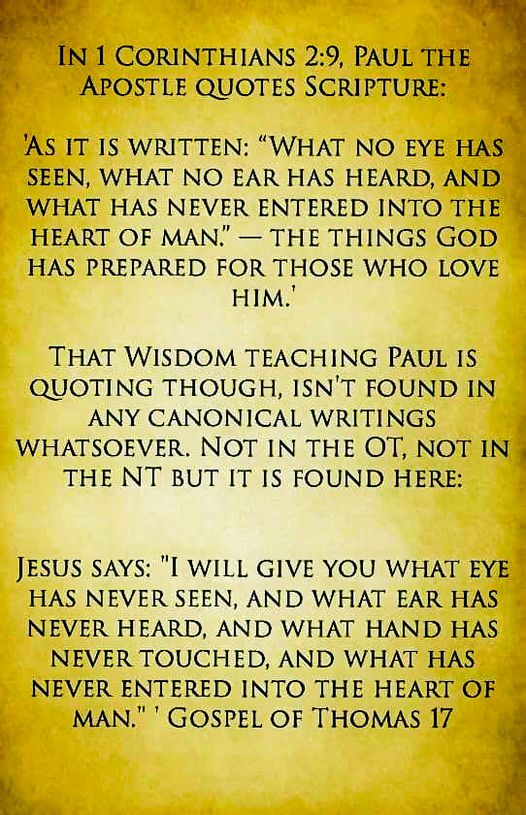

 The Gospel of Thomas is arguably the most
important writing known to man today.
Why? Important spiritual
teachings were removed from the traditional
Gospels by the Church.
In
the words of Prof. Bart D. Ehrman in his
book, The Orthodox Corruption of
Scripture, where he warns us that:
"...theological disputes, specifically
disputes over Christology, prompted
Christian scribes to alter the words of
scripture in order to make them more
serviceable for the polemical task. Scribes
modified their manuscripts to make them more
patently ‘orthodox’ and less susceptible to
‘abuse’ by the opponents of orthodoxy"
--
which orthodoxy was to bring the text of the
Bible into conformity with the doctrines and
tenets of the Church of the Roman Emperor
Constantine. In his book The Text
of the New Testament, Dr. Vincent Taylor
writes that
"The manuscripts of the New Testament
preserve traces of two kinds of dogmatic
alterations: those which involve the
elimination or alteration of what was
regarded as doctrinally unacceptable or
inconvenient, and those which introduce into
the Scriptures proof for a favorite
theological tenet or practice".
(see
The Gospel of Thomas is arguably the most
important writing known to man today.
Why? Important spiritual
teachings were removed from the traditional
Gospels by the Church.
In
the words of Prof. Bart D. Ehrman in his
book, The Orthodox Corruption of
Scripture, where he warns us that:
"...theological disputes, specifically
disputes over Christology, prompted
Christian scribes to alter the words of
scripture in order to make them more
serviceable for the polemical task. Scribes
modified their manuscripts to make them more
patently ‘orthodox’ and less susceptible to
‘abuse’ by the opponents of orthodoxy"
--
which orthodoxy was to bring the text of the
Bible into conformity with the doctrines and
tenets of the Church of the Roman Emperor
Constantine. In his book The Text
of the New Testament, Dr. Vincent Taylor
writes that
"The manuscripts of the New Testament
preserve traces of two kinds of dogmatic
alterations: those which involve the
elimination or alteration of what was
regarded as doctrinally unacceptable or
inconvenient, and those which introduce into
the Scriptures proof for a favorite
theological tenet or practice".
(see


 The
mind evolves beyond the level of what Paul
portrayed as an
"animal-soul" level of
consciousness, through the interaction of
the divided spheres of the Tree of Knowledge
(aka Tree of Duality) which form the outer
columns of the Tree of Life as patterned in
the diagram at the right. And
this is explored in great detail and depth
at
The
mind evolves beyond the level of what Paul
portrayed as an
"animal-soul" level of
consciousness, through the interaction of
the divided spheres of the Tree of Knowledge
(aka Tree of Duality) which form the outer
columns of the Tree of Life as patterned in
the diagram at the right. And
this is explored in great detail and depth
at 


 In
the account of Jacob's Ladder, there are
angels personified as ascending and
descending up and down the Ladder. And
this exchange of thoughts (angels) between
the lower and upper mind is the embodiment
of the commandment to seek no other teacher
than the Indwelling Logos/Son of God (see
In
the account of Jacob's Ladder, there are
angels personified as ascending and
descending up and down the Ladder. And
this exchange of thoughts (angels) between
the lower and upper mind is the embodiment
of the commandment to seek no other teacher
than the Indwelling Logos/Son of God (see
 It will be
impossible for the seeker to grasp the reality of not only the Gospel of
Thomas, but all the Gospels and all Scripture, without first understanding
the mindset and spiritual objectives of the authors of the Sacred Writings.
And for the first time in over 2000 years, the mindset and spiritual
objectives of the original authors has been revealed and made known in the
article,
It will be
impossible for the seeker to grasp the reality of not only the Gospel of
Thomas, but all the Gospels and all Scripture, without first understanding
the mindset and spiritual objectives of the authors of the Sacred Writings.
And for the first time in over 2000 years, the mindset and spiritual
objectives of the original authors has been revealed and made known in the
article, 


 Divine
Strategery: How God Fools Mankind - Keeping
Him Ignorant Of The Truth: Strategery
has become synonymous with when what is
portrayed as simple, simpleminded, or even
self-evident, is able to dupe and thwart an
opposing force that perceives itself to be
either superior, or to suppose they know the
answers. Divine Strategery is how God
fools all the religious leaders of this
world who think they
doctrinally
know God -- all the would-be teachers and
philosophers of this world who think they
Know Truth
-- all the Atheists and those who criticize
and denounce the existence of God by virtue
of their limited perception and
understanding -- and all the people in this
world who think they understand the purpose
of life and the world in which we presently
dwell. As prodigal sons and daughters of
our Heavenly Father, if the people in this
life knew the answers, then the learning
experience of
God's SchoolHouse of this world would
not effectively evolve us to become true
Brothers and Sisters of our Elder Brother
Yeshua/Jesus. Therefore, in order to insure
that each of us is immersed in the necessary
learning experience that this life offers,
all people are equally fooled into thinking
they know, in order for them to be
manipulated into embracing a higher agenda
that is beyond their ability to even
imagine. Thus, Divine Strategery!!!
Divine
Strategery: How God Fools Mankind - Keeping
Him Ignorant Of The Truth: Strategery
has become synonymous with when what is
portrayed as simple, simpleminded, or even
self-evident, is able to dupe and thwart an
opposing force that perceives itself to be
either superior, or to suppose they know the
answers. Divine Strategery is how God
fools all the religious leaders of this
world who think they
doctrinally
know God -- all the would-be teachers and
philosophers of this world who think they
Know Truth
-- all the Atheists and those who criticize
and denounce the existence of God by virtue
of their limited perception and
understanding -- and all the people in this
world who think they understand the purpose
of life and the world in which we presently
dwell. As prodigal sons and daughters of
our Heavenly Father, if the people in this
life knew the answers, then the learning
experience of
God's SchoolHouse of this world would
not effectively evolve us to become true
Brothers and Sisters of our Elder Brother
Yeshua/Jesus. Therefore, in order to insure
that each of us is immersed in the necessary
learning experience that this life offers,
all people are equally fooled into thinking
they know, in order for them to be
manipulated into embracing a higher agenda
that is beyond their ability to even
imagine. Thus, Divine Strategery!!!


